How to Get Affordable Dental Implants (That Won't Fail)
Affordable dental implants are implant systems and treatment strategies that reduce the typical $3,000–$7,000 cost of a single implant to as low as $1,500–$2,500. Cost-saving options include dental school clinics (40–60% discounts), FDA-cleared budget brands like Osstem and Dentium, clinical trials offering free or reduced-cost treatment, dental tourism to accredited clinics in Mexico and Costa Rica, Community Health Centers with sliding-fee scales, and financing plans with 0% APR through CareCredit or LendingClub.
The average cost of a single dental implant in the United States — $3,500 to $5,500 — puts this gold-standard restoration out of immediate reach for many patients. When you need multiple implants or a full-arch reconstruction, the total can exceed $50,000. But giving up on implants entirely means settling for less durable, less comfortable alternatives that compromise both oral health and quality of life.
This guide presents seven clinically-vetted strategies to reduce your implant cost by 20–70% without sacrificing the safety, longevity, or esthetic quality of your restoration. Every option listed here uses FDA-cleared implant systems and board-certified providers.
Why Dental Implants Cost So Much (The Real Reasons)
Understanding why implants are expensive helps you identify where legitimate savings exist versus where cutting corners creates risk:
- Specialist training: Implant placement is performed by oral and maxillofacial surgeons, periodontists, or prosthodontists who have completed 3–6 years of post-doctoral surgical training beyond dental school.
- Biocompatible materials: The implant fixture is manufactured from Grade 4 or Grade 5 medical-grade titanium or Y-TZP zirconia, precision-machined to sub-micron tolerances. Surface treatment technologies (sandblasting, acid etching, or proprietary coatings like Straumann's SLActive®) further add to the manufacturing cost.
- Multi-stage workflow: A typical implant case involves CBCT imaging, surgical placement, 3–6 months of osseointegration, abutment connection, and final crown fabrication — each requiring separate appointments and lab fees.
- Overhead: The sterile surgical environment, implant motor systems, surgical guides, and digital scanners represent significant capital investment for the practice.
See our complete cost breakdown guide for pricing detail on every component.
Dental Schools: Board-Supervised Care at 30–50% Off
Why Dental School Clinics Are the Best-Kept Secret
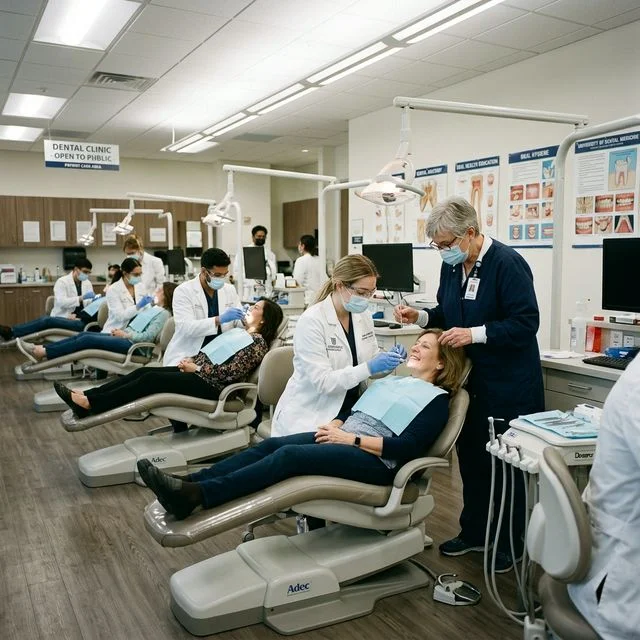
Accredited university dental school clinics offer the single best combination of quality and affordability in the US market. Here's why:
- Who performs the surgery: Graduate-level residents — dentists who have already earned their DDS/DMD degree and are training to become board-certified specialists in oral surgery, periodontics, or prosthodontics.
- Faculty oversight: Every procedure is directly supervised (often step-by-step) by experienced attending faculty members, many of whom are published researchers and recognized leaders in implantology.
- Savings magnitude: 30–50% below private practice rates. A single implant that costs $4,500 at a private practice might be $2,500–$3,000 at a dental school clinic.
- Leading programs: CODA-accredited programs include NYU College of Dentistry, University of Michigan, UCSF, University of Texas Health San Antonio, and University of Pennsylvania all operate high-volume implant clinics.
Trade-offs: Appointments typically take 2–3× longer due to the teaching environment, and waitlists can span 2–6 months. However, the clinical outcomes are statistically equivalent to private practice care.
Dental Discount Plans vs Insurance
Two Different Savings Mechanisms
For patients without employer-sponsored dental insurance, two options exist — and they work very differently:
| Feature | Dental Insurance | Dental Discount Plan |
|---|---|---|
| Annual Cost | $300–$600/year | $80–$200/year |
| Annual Maximum | $1,500–$2,500 | No cap |
| Waiting Period | 6–12 months for major procedures | None (immediate) |
| Typical Implant Savings | Up to $1,500 (capped by annual max) | 20–40% off full fee |
| Best For | Patients needing routine + one implant | Multiple implants, full arch |
Popular discount plans include Careington 500, Aetna Dental Access, and DentalPlans.com networks. Calculate your potential insurance savings with our Insurance Savings Calculator.
Cross-Border Dental Tourism (Safety Checklist)
Saving 50–70% Safely
An estimated 800,000+ Americans travel abroad for dental care annually, primarily to Mexico, Costa Rica, Colombia, and Thailand. Savings of 50–70% are achievable, but the clinical risks are real and must be carefully managed.
Before committing, verify ALL of the following:
- Implant brand: The clinic must use an internationally recognized system — Straumann, Nobel Biocare, Osstem, or Zimmer Biomet. If they use a proprietary or unknown brand, a US dentist won't have the prosthetic components to maintain or repair your restoration.
- Provider credentials: Verify the surgeon holds a board certification equivalent (e.g., ABOMS equivalent in Mexico is the Consejo Nacional de Cirugía Oral y Maxilofacial).
- Written treatment records: Demand a complete chart including CBCT scans, implant lot numbers, torque values, and post-operative radiographs — your US dentist will need these for follow-up care.
- Follow-up plan: Osseointegration monitoring (typically at 3, 6, and 12 months) must be arranged with a local US provider. Factor this follow-up cost into your total budget.
Popular dental tourism destinations include Los Algodones (Mexico), San José (Costa Rica), and Medellín (Colombia). Compare brands available at these clinics using our Brand Comparator.
Financing Options: CareCredit, LendingClub & In-House Plans
0% APR and Fixed-Payment Options
If upfront payment isn't feasible, structured financing can make implants accessible immediately:
- CareCredit: The most widely accepted healthcare credit card, offering 0% APR for 6, 12, 18, or 24 months. Accepted by over 260,000 dental providers. Caution: Deferred interest means if you don't pay in full by the promo end date, you owe retroactive interest on the entire balance.
- LendingClub Patient Solutions: Fixed monthly payments with APR from 3.99–24.99%. No deferred interest structure — what you see is what you pay.
- Proceed Finance: Specifically designed for patients with lower credit scores (580+). Higher APR but broader approval rates.
- In-house payment plans: Many private practices offer their own installment plans — typically 10–20% down with the remainder split over 6–18 months. These often don't require a hard credit pull.
Model your monthly payments with our Financing Calculator, and read our complete payment plans guide for a detailed comparison of all financing programs available in 2026.
Community Health Centers & VA Programs
Two often-overlooked resources provide subsidized or free implant care for qualifying patients:
- Federally Qualified Health Centers (FQHCs): Over 1,400 centers nationwide provide dental services on a sliding fee scale based on household income. While not all FQHCs offer implant surgery, many have referral partnerships with local oral surgeons who honor the sliding scale. Find your nearest center at findahealthcenter.hrsa.gov.
- Veterans Affairs (VA) Dental: Veterans with a service-connected dental condition, 100% disability rating, or former POW status qualify for comprehensive VA dental care, including implants, at no cost. VA dental clinics use high-quality implant systems and employ board-certified specialists.
- Donated Dental Services (DDS): A national program that connects elderly, disabled, or medically compromised patients with volunteer dentists who provide free treatment, including implants.
Mini Implants & Budget Alternatives
When traditional implants exceed your budget even after exploring the options above, consider these alternatives:
- Mini dental implants (MDIs): Smaller-diameter implants (1.8–3.0 mm vs 3.5–5.0 mm standard) that cost roughly 50% less and often don't require bone grafting. Best suited for anchoring lower dentures; not recommended for single-tooth replacement in high-force areas. Compare with traditional implants using our Implant vs Alternatives Calculator.
- Implant-supported overdentures: Just 2–4 implants can stabilize a complete denture, providing dramatically better retention than adhesive alone. Total cost: $8,000–$15,000 per arch vs $25,000+ for a fixed All-on-4.
- Mid-range implant systems: Brands like Osstem, Hiossen, Dentium, and MIS Implants offer FDA-cleared systems at 30–50% below premium Swiss/Swedish pricing with published success rates exceeding 95%. See our brand comparison guide, or read our best budget dental implants ranking for a detailed comparison of the most cost-effective FDA-cleared systems.
Regardless of which cost-saving strategy you pursue, never compromise on the fundamentals: a board-certified provider, an FDA-cleared implant system, and a comprehensive treatment plan based on 3D imaging. The cheapest implant is the one that lasts a lifetime. Learn what to expect during the procedure, or estimate your total investment with our Cost Calculator.
State-by-State Affordability Index
Dental implant costs vary by as much as 40% across US states due to differences in provider density, overhead costs, and local cost of living. Patients willing to travel even 100–200 miles to a neighboring state can achieve meaningful savings without leaving the country:
| Affordability Tier | States | Single Implant (Avg) | Savings vs National Avg |
|---|---|---|---|
| Most Affordable | Texas, Florida, Arizona, Indiana | $3,000–$4,200 | 15–30% below national avg |
| Moderate | Ohio, Michigan, Colorado, Georgia | $3,500–$4,800 | 5–15% below |
| Above Average | California, New York, Massachusetts | $4,500–$6,500 | At or above national avg |
Even within expensive states, university dental school clinics often provide implant treatment at rates comparable to the "Most Affordable" tier above. Check our state-by-state guides for local dental school availability and pricing: California, Texas, New York, Florida, and 46 more.
How to Negotiate With Your Dentist
5 Proven Negotiation Strategies
Most patients don't realize that dental fees are not fixed — private practice pricing has room for negotiation, especially for implant cases that represent significant revenue. Here are evidence-based negotiation strategies:
- Get multiple written quotes: Request line-item estimates from at least 2–3 providers. Use CDT codes (D6010, D6057, D6058) to ensure you're comparing identical procedures. Our cost breakdown guide explains each code.
- Ask about cash/prepay discounts: Many practices offer 5–15% discounts for full upfront payment, since they avoid credit card processing fees and collection risk.
- Inquire about mid-range implant brands: If your surgeon defaults to Straumann or Nobel Biocare, ask whether an equally effective system like Osstem, Zimmer Biomet, or BioHorizons could reduce your fixture cost by $500–$1,500 per implant.
- Bundle multiple procedures: If you need more than one implant, ask for package pricing. Multi-implant cases often qualify for per-unit discounts of 10–20%.
- Time your treatment strategically: Some practices offer promotional pricing during slower months (January–February, September). End-of-year timing can also maximize dental insurance benefits that reset annually.
Important: Never negotiate on clinical quality — the surgeon's experience, implant brand quality, and imaging standards should remain non-negotiable. Only negotiate on fair-fee scheduling, payment structure, and brand-tier selection where clinically appropriate.
Timeline: When to Start Saving for Dental Implants
Monthly Savings Targets by Scenario
Planning ahead can dramatically reduce financial stress. Here's a realistic savings timeline for common implant scenarios, assuming you're setting aside money monthly while also exploring the cost-reduction strategies discussed above:
| Scenario | Estimated Cost (After Savings Strategies) | Monthly Savings Needed (12 mo) | Monthly Savings Needed (24 mo) |
|---|---|---|---|
| Single implant (dental school + mid-range brand) | $2,000–$3,000 | $167–$250 | $83–$125 |
| Single implant (private practice + premium brand) | $4,000–$5,500 | $333–$458 | $167–$229 |
| Full arch All-on-4 (dental school) | $10,000–$18,000 | $833–$1,500 | $417–$750 |
If saving the full amount isn't feasible, consider hybrid financing: save for the down payment (typically 10–20% of the total), then finance the remainder through a 0% APR CareCredit or LendingClub plan. Model your exact monthly payments with our Financing Calculator, or estimate your total cost with the Cost Calculator.
Ready to take the next step? Understand the full implant procedure step-by-step, compare implants to dentures for your situation, or explore which implant brand offers the best value for your case. Track your post-surgery recovery day by day once you've committed to treatment.
Cost Comparison: Where to Save on Dental Implants in 2026
The following table compares the average cost of a single dental implant (including abutment and crown) across different treatment settings in the US:
| Treatment Setting | Single Implant Cost | Full Arch (All-on-4) | Savings vs Private Practice | Trade-offs |
|---|---|---|---|---|
| Private Practice (Baseline) | $3,000–$7,000 | $15,000–$30,000 | — | Fastest scheduling, most experienced surgeons |
| Dental School Clinic | $1,500–$3,000 | $8,000–$15,000 | 40–60% | Longer appointments, student performs under supervision |
| Community Health Center (FQHC) | $1,200–$3,500 | Varies | 30–50% | Income-based sliding fee; limited availability |
| Clinical Trial | Free–$1,500 | Varies | Up to 100% | Strict eligibility; experimental protocols |
| Dental Tourism (Mexico) | $900–$1,800 | $5,000–$12,000 | 50–70% | Travel costs; follow-up coordination; quality varies |
| Budget Brand (US clinic) | $2,000–$4,000 | $10,000–$20,000 | 20–40% | FDA-cleared but fewer long-term studies |
For a personalized estimate based on your city, see our city-by-city cost guide or cost calculator.
Dental School Implant Programs: 2026 Directory
University dental schools provide implant treatment at 40–60% below private practice rates. All procedures are performed by advanced dental students or residents under the direct supervision of licensed, experienced faculty. The quality of materials and implant systems used is identical to private practices.
Top Dental Schools for Implant Treatment
The following institutions are recognized for strong implant training programs with active patient clinics:
- Loma Linda University School of Dentistry (CA) — Comprehensive implant program with digital treatment planning
- University of Michigan School of Dentistry (MI) — Runs the dedicated "SenIOR" implant program for older adults (launched January 2025), studying implant overdentures for seniors
- University of Pennsylvania School of Dental Medicine (PA) — Advanced surgical placement, bone grafting, and implant restoration training
- NYU College of Dentistry (NY) — One of the largest dental schools in the US, high patient volume
- Tufts University School of Dental Medicine (MA) — Comprehensive implant program with competitive patient pricing
- MUSC (Medical University of South Carolina) — Implant services through the advanced education program
What to Expect
- Appointments are longer than private practice (2–4 hours vs 1–2 hours) due to the teaching environment
- Treatment timeline extends — the entire process may take 8–12 months instead of 4–6 months
- Screening process: You will be evaluated for suitability; not all cases are accepted (complex cases may be prioritized for teaching value)
- Wait time: 2–6 months to begin treatment due to high demand
To find dental schools near you, visit the American Dental Education Association (ADEA) school directory or search "dental school implant clinic [your state]."
Clinical Trials: Free or Reduced-Cost Dental Implants
Dental implant clinical trials offer access to advanced treatment at significantly reduced cost — sometimes entirely free. Here are active and upcoming trials relevant to 2025–2026:
Currently Active Trials
- Hiossen EK III NH Implant System Study (NCT06651502) — Evaluating efficacy of immediate restoration with the Hiossen EK III system. Estimated completion: December 2026. Check ClinicalTrials.gov for recruitment sites.
- University of Pennsylvania — TNF-alpha Inhibitor Study — Investigating dental implant healing in patients taking TNF-alpha inhibitors (for autoimmune conditions). Implant placement is fully covered for participants who complete all study visits. Actively recruiting.
- Soft Tissue Changes Study — Recruiting adults aged 20–80 with good general health who need single-tooth replacement in the aesthetic zone and have adequate bone. Updated June 2025.
How to Find Trials
- ClinicalTrials.gov — Search "dental implant" and filter by "Recruiting" status and your location
- TrialX.com — Volunteer matching service for dental studies
- Local dental school websites — Many schools list active research studies seeking participants
What to know: Clinical trials have strict eligibility criteria (age, health status, specific dental conditions). You may receive an experimental implant system or protocol. All trials are reviewed by Institutional Review Boards (IRB) for patient safety.
Medicaid Dental Implant Coverage by State (2026)
Medicaid dental coverage varies dramatically by state, and most states historically exclude dental implants. However, recent expansions are changing this landscape:
States That Improved Adult Dental Medicaid Benefits in 2025
Seven states expanded their adult dental Medicaid benefits to "enhanced coverage" (diagnostic, preventive, and restorative procedures), often with annual spending limits of $1,000+ or no limit:
- Georgia
- Indiana
- Kansas
- Kentucky
- Missouri
- Oklahoma
- Utah
Notable State-Specific Policies
- New York: As of January 2024, replacement dentures and implants may only require a dentist's recommendation to determine medical necessity for Managed Long Term Care (MLTC) and mainstream Medicaid managed care plans — opening a potential pathway for implant coverage.
- California: Denti-Cal (Medi-Cal dental) expanded adult dental benefits in 2022, but implants remain limited to cases deemed medically necessary.
Action step: Contact your state Medicaid office directly to ask about dental implant coverage. Even in states without explicit implant coverage, some Managed Care Organizations (MCOs) may approve implants on a case-by-case "medical necessity" basis — particularly when tooth loss affects nutrition or speech.
Financing Options: Making Implants Affordable Without Paying Upfront
Even without insurance or Medicaid coverage, several financing tools can spread the cost of dental implants over months or years:
Third-Party Financing
| Provider | Promotional Rate | Term Options | Credit Requirements |
|---|---|---|---|
| CareCredit | 0% APR for 6–24 months | 6, 12, 18, 24 months | Fair to Good (640+) |
| LendingClub Patient Solutions | 0% APR for 6–24 months | 6–84 months | Good (660+) |
| Proceed Finance | 0% APR for 6–12 months | 6–60 months | Fair (600+) |
| Cherry Patient Financing | 0% APR for 6 months | 6–24 months | No hard credit check |
In-House Dental Office Payment Plans
Many dental practices offer their own payment plans with no interest, no credit check, and monthly payments of $150–$400. Ask your dentist about in-house financing before applying for third-party loans.
FSA and HSA Accounts
If your employer offers a Flexible Spending Account (FSA) or you have a Health Savings Account (HSA), dental implants are an eligible expense. You can use pre-tax dollars to pay for implants, effectively saving 20–30% on your marginal tax rate.
Model your monthly payment with our dental financing calculator →
Budget Implant Brands: Are They Worth It?
Not all dental implant systems cost the same. "Budget" or "value-tier" brands are FDA-cleared implant systems manufactured primarily in South Korea and other Asian countries that offer significantly lower pricing than premium European brands:
| Brand Tier | Examples | Fixture Cost to Dentist | Patient Cost (avg) | 5-Year Data Available? |
|---|---|---|---|---|
| Premium | Straumann, Nobel Biocare | $300–$500 | $4,000–$7,000 | Yes (20+ year studies) |
| Mid-tier | BioHorizons, Zimmer Biomet | $150–$300 | $3,000–$5,000 | Yes (10+ year studies) |
| Budget | Osstem, Dentium, MegaGen, Hiossen | $50–$150 | $2,000–$4,000 | Limited (5–8 year studies) |
Are budget brands safe? Yes — all brands sold in the US must be FDA-cleared. Korean brands like Osstem and Dentium now represent over 20% of the global market and have extensive clinical data in Asia. However, they typically have fewer long-term (15+ year) Western studies compared to Straumann or Nobel Biocare.
Compare brands in detail: Complete brand comparison guide → | Side-by-side brand comparator tool →
Dental Tourism for Implants: A Realistic Assessment
Traveling abroad for dental implants can save 50–70% on the procedure cost. The most popular destinations for US patients include:
| Destination | Single Implant Cost | All-on-4 Cost | Quality Accreditation | Travel Time (from US) |
|---|---|---|---|---|
| Mexico (Los Algodones, Tijuana, Cancún) | $900–$1,800 | $5,000–$10,000 | ADA-recognized; JCI-accredited clinics available | 1–4 hours (border cities) |
| Costa Rica (San José) | $1,000–$2,000 | $6,000–$12,000 | JCI accreditation; US-trained dentists common | 3–5 hours |
| Colombia (Bogotá, Medellín) | $800–$1,500 | $5,000–$10,000 | Growing medical tourism infrastructure | 4–6 hours |
| Turkey (Istanbul) | $500–$1,200 | $4,000–$8,000 | JCI-accredited hospitals; package deals common | 10–12 hours |
Risks and Considerations
- Follow-up care: Implant treatment requires multiple visits. If complications arise after returning home, local dentists may charge full price to correct issues.
- Quality variation: Not all overseas clinics use the same implant brands or follow the same protocols. Verify the specific implant system used and ensure it is internationally recognized.
- Warranty: Most overseas clinics do not honor warranties if you seek follow-up from a different provider in the US.
- Total cost: Factor in flights, hotels (2–3 trips may be needed), and potential follow-up costs when comparing to US pricing.
Community Health Centers (FQHCs): Sliding-Fee Implants
Federally Qualified Health Centers (FQHCs) are a highly underutilized resource for affordable dental care. These government-funded clinics use a sliding fee scale based on your income — meaning if your income is low, you pay significantly less, regardless of insurance status.
- How to find one: Visit findahealthcenter.hrsa.gov and search by ZIP code
- What they offer: Many FQHCs now provide implant services in addition to standard dental care. However, availability varies by location — Call ahead to confirm implant services.
- Cost: Based on your household income relative to the Federal Poverty Level (FPL). At 200% FPL, you may pay only 25–50% of standard charges.