Dental Implants vs Dentures: The Complete Comparison
Dental implants and dentures are the two primary options for replacing missing teeth. Implants are surgically anchored titanium posts that support permanent crowns ($3,000–$7,000 per tooth in 2026), while dentures are removable prosthetics resting on the gums ($1,000–$3,000 for a full set). Implants last 25+ years with a 95–98% success rate and prevent bone loss; dentures typically require replacement every 5–10 years and can accelerate jawbone resorption.
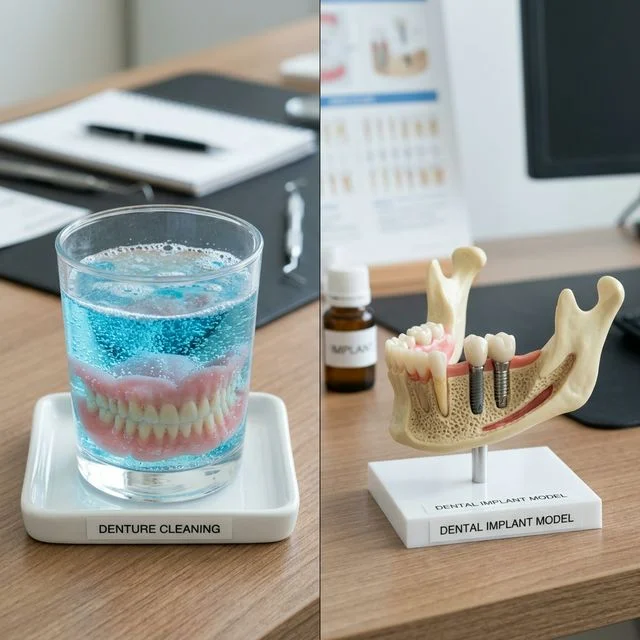
When faced with replacing missing teeth, the two most common options are dental implants and dentures. While both restore function and appearance, they differ fundamentally in structure, longevity, comfort, and long-term cost. This guide provides an evidence-based, side-by-side comparison to help you make the right choice for your unique clinical situation, budget, and lifestyle.
Key Differences at a Glance
| Factor | Dental Implants | Traditional Dentures |
|---|---|---|
| Structure | Titanium screw fused to jawbone + crown | Acrylic/metal framework resting on gums |
| Lifespan | 25+ years (often lifetime) | 5–10 years before replacement |
| Upfront Cost (Full Arch) | $15,000–$35,000 | $1,500–$5,000 |
| 30-Year Cost | $15,000–$35,000 (one-time) | $9,000–$30,000 (3–6 replacements) |
| Bone Preservation | Stimulates bone, prevents resorption | Accelerates bone loss over time |
| Chewing Efficiency | 90–95% of natural teeth | 25–40% of natural teeth |
| Maintenance | Brush, floss, regular dental check-ups | Nightly soaking, adhesives, relines |
| Surgery Required | Yes (outpatient) | No (impressions only) |
Use our Implant vs Alternatives Calculator to model the cost difference over your expected lifetime.
Cost Comparison: Short-Term vs Long-Term
The True 30-Year Cost Equation
Dentures win on upfront cost — a complete set of conventional dentures costs $1,500–$5,000, while an implant-supported full arch restoration ranges from $15,000–$35,000. However, the long-term economics dramatically shift in favor of implants:
- Denture replacement cycle: Traditional dentures need relining every 2–3 years ($300–$500 each) and full replacement every 5–10 years. Over 30 years, denture costs can total $15,000–$30,000 when factoring in relines, new sets, adhesives, and repair visits.
- Implant longevity: With proper maintenance, dental implants have a documented 95%+ survival rate at 20 years. The crown may need replacement once (at ~15 years), but the implant fixture itself is designed to last a lifetime.
- Hidden denture costs: Bone resorption from denture wear eventually changes facial structure, potentially requiring costly bone grafting if you decide to switch to implants later — a procedure that becomes more complex and expensive with each passing year of denture use.
Estimate your complete procedure cost with our Cost Calculator, or read the full cost breakdown guide.
Comfort, Fit & Daily Life
This is where the patient experience diverges most sharply:
- Implants feel natural: Because they fuse directly with your jawbone through osseointegration, implants function like natural teeth. There is no slippage, no adhesive, and no "foreign body" sensation. You can eat steak, bite into apples, and laugh without worry.
- Dentures require adaptation: New denture wearers typically need 2–4 weeks to adjust to speaking and eating. Even well-fitted dentures can shift during meals (especially with hard or sticky foods), causing discomfort, sore spots, and embarrassment. Lower dentures are particularly prone to poor retention due to the narrow, U-shaped mandibular ridge.
- Taste and sensation: Upper dentures cover the palate, significantly reducing taste sensation and temperature sensitivity during meals. Implant-supported prostheses leave the palate completely unobstructed.
Durability & Replacement Timelines
The longevity comparison is unambiguous:
| Component | Expected Lifespan |
|---|---|
| Implant fixture (titanium screw) | 25+ years, often lifetime |
| Implant crown (porcelain/zirconia) | 10–20 years |
| Implant abutment | 15–25 years |
| Conventional complete denture | 5–10 years |
| Denture reline | Every 2–3 years |
| Implant-supported overdenture | 10–15 years (denture portion) |
Premium implant brands like Straumann and Nobel Biocare offer lifetime warranties on the implant fixture. Compare warranty coverage across manufacturers with our Brand Comparator.
Impact on Jawbone Health
Bone Resorption: The Hidden Cost of Dentures
This factor is often underestimated but is clinically one of the most important:
- Bone stimulation: Natural tooth roots transmit chewing forces to the alveolar bone, maintaining its density and volume. Dental implants replicate this biomechanical stimulus through osseointegration — the direct structural connection between titanium and bone.
- Denture-induced resorption: Without root stimulation, the jawbone beneath dentures resorbs at a rate of approximately 0.5–1.0 mm per year. Over a decade, this causes significant facial collapse ("sunken face" appearance), loss of denture fit, and increasingly difficult implant placement if the patient later decides to switch.
- Clinical recommendation: The American College of Prosthodontists recommends implant-retained overdentures as the minimum standard of care for edentulous (toothless) mandibles, specifically because they preserve bone volume far better than conventional dentures.
When Dentures Are the Better Choice
Dentures remain a valid and appropriate option in specific circumstances:
- Severe bone loss: Patients with advanced alveolar atrophy who are unable or unwilling to undergo bone grafting or zygomatic implant placement.
- Medical contraindications: Uncontrolled diabetes, active radiation therapy to the jaw, immunosuppressive therapy, or high-dose bisphosphonate use (risk of medication-related osteonecrosis of the jaw, or MRONJ) may make implant surgery inadvisable.
- Immediate need: Patients who need same-day tooth replacement while waiting for a longer-term implant treatment plan.
- Budget constraints with no financing options: When dental school clinics, discount plans, and financing options have all been exhausted, quality dentures remain a functional solution.
When Implants Are Worth the Investment
For most patients, implants offer superior clinical outcomes and quality of life:
- Active adults under 65: The earlier you invest in implants, the more decades of benefit you receive — and the more bone you preserve.
- Patients frustrated with denture adhesive: Implant-supported overdentures (just 2–4 implants) eliminate the need for adhesive and dramatically improve retention for as little as $8,000–$12,000 per arch.
- Single or partial tooth loss: A single implant or implant-supported bridge is almost always preferable to a removable partial denture, which places stress on adjacent natural teeth.
- Patients prioritizing nutrition: Studies show denture wearers consume significantly fewer raw vegetables, nuts, and fibrous proteins due to reduced chewing efficiency — impacting overall nutritional health.
Ready to explore your options? Learn about the step-by-step implant procedure, compare implant brands, or discover ways to reduce your implant cost. Use our Recovery Timeline tool to understand the healing process if you choose implants.
The Hybrid Solution: Implant-Supported Overdentures Explained
The McGill Consensus Standard of Care
For patients who want better stability than traditional dentures but can't afford — or don't qualify for — a fixed full-arch restoration like All-on-4®, implant-supported overdentures represent the ideal middle ground. Read our detailed guide to implant-supported dentures for a full comparison of snap-on vs fixed options. The McGill Consensus Statement (2002, reaffirmed 2009) established that a two-implant overdenture should be considered the minimum standard of care for the edentulous mandible:
| Feature | Traditional Denture | Implant-Supported Overdenture | Fixed All-on-4 |
|---|---|---|---|
| Implants Required | None | 2–4 | 4–6 |
| Removable? | Yes (loose) | Yes (snap-on retention) | No (fixed) |
| Cost per Arch | $1,500–$5,000 | $8,000–$15,000 | $15,000–$35,000 |
| Bone Preservation | None | Significant (in implant areas) | Maximum |
| Chewing Efficiency | 25–40% | 60–80% | 90–95% |
| Need for Adhesive? | Yes | No | No |
Overdentures use ball attachments or Locator® abutments to snap securely onto the implants, yet can be removed for cleaning. This design simplifies maintenance and reduces long-term repair costs. Estimate the cost difference with our Implant vs Alternatives Calculator, For a comprehensive overview of all full-arch options, read our full mouth dental implants guide. Compare the implant systems commonly used for overdentures — Straumann, Osstem, and Zimmer Biomet all offer dedicated overdenture components.
What About Dental Bridges? The Third Alternative
Bridge vs Implant: Key Differences
While this guide focuses on implants vs dentures, many patients also consider a fixed dental bridge — a prosthetic that spans the gap left by one or more missing teeth, anchored by crowns cemented onto the adjacent natural teeth. Bridges are a viable option for replacing 1–3 consecutive teeth when the neighboring teeth are healthy and strong enough to serve as abutments.
| Factor | Dental Implant | Fixed Bridge |
|---|---|---|
| Upfront Cost | $3,500–$5,500 per tooth | $2,500–$5,000 for 3-unit bridge |
| Lifespan | 25+ years (fixture), 10–20 years (crown) | 10–15 years |
| Adjacent Teeth | No alteration required | Requires grinding down healthy neighboring teeth |
| Bone Preservation | Yes — stimulates jawbone | No — bone resorbs under the pontic |
| Surgery Required | Yes | No |
| Best For | Single or multiple non-adjacent missing teeth | 1–3 adjacent missing teeth with strong neighbors |
The primary drawback of bridges is that they sacrifice healthy tooth structure on the abutment teeth — a trade-off that is irreversible. If an abutment tooth develops decay or fractures under the bridge, the entire restoration (and potentially the abutment tooth) may be lost. For this reason, most prosthodontists now recommend implants over bridges when the patient is a surgical candidate. Learn more about the implant procedure and associated costs.
Patient Scenario: Making the Right Choice for Your Situation
Two Real-World Cases
Consider two patients facing full-arch tooth loss:
James, age 52, healthy, moderate bone density: James is an active professional who wants a permanent solution. He has dental insurance with a $2,000 annual maximum and can finance the remainder. Best option: All-on-4® implants using a mid-range system like Osstem or Zimmer Biomet at a dental school clinic, reducing his cost from $25,000 to approximately $15,000–$18,000 per arch. He finances the balance through CareCredit at 0% APR for 24 months. Use our Financing Calculator to model this scenario.
Dorothy, age 74, type 2 diabetes (HbA1c 7.8%), moderate bone loss: Dorothy's diabetes is borderline but manageable, and she experiences daily frustration with adhesive on her lower denture. Best option: Two-implant overdenture for the lower arch ($8,000–$12,000), keeping her existing upper denture. This provides dramatic improvement in retention and chewing efficiency at a fraction of the fixed implant cost. Read about the procedure sequence and track recovery day by day.
Decision Framework: Choosing Between Implants and Dentures
Clinical Decision Matrix
Use this clinical decision matrix to guide your conversation with your dental provider. Each factor should be weighed according to your personal priorities:
| If You… | Consider | Why |
|---|---|---|
| Are under 60 with good bone | Full implants | Maximum decades of benefit, bone preservation |
| Have severe bone loss, refuse grafting | Overdenture (2–4 implants) | Improved retention without extensive surgery |
| Have uncontrolled diabetes or take bisphosphonates | Traditional dentures (for now) | Medical risk outweighs implant benefit until conditions stabilize |
| Need something immediately | Immediate dentures → implants later | Function restored now, transition when ready |
| Want to budget gradually | Start with 2 implants → upgrade later | Overdenture today, convert to fixed prosthesis once budget allows |
No matter which path you choose, get a clear understanding of costs, explore affordability strategies, research the implant brands your provider uses, and find state-specific pricing in your area. Estimate your total investment with our Cost Calculator or compare options with the Full Mouth Cost Calculator.
Head-to-Head Comparison: Implants vs Dentures at a Glance
| Factor | Dental Implants | Traditional Dentures | Implant-Supported Dentures |
|---|---|---|---|
| 2026 Cost | $3,000–$7,000 per tooth; $15,000–$30,000 per arch (All-on-4) | $1,000–$3,000 per full set | $15,000–$30,000 per jaw |
| Lifespan | 25+ years (lifetime with care) | 5–10 years (avg: upper 10.3 yrs, lower 8.6 yrs) | 15–20 years (implants); denture part: 10–15 yrs |
| Success Rate | 95–98% (5-year); 92% at 20 years | 90–95% (initial satisfaction, if well-fitted) | 95–97% |
| Bone Preservation | Stimulates jawbone, prevents resorption | Accelerates bone loss (no stimulation + pressure) | Partially preserves bone at implant sites |
| Chewing Ability | 80–90% of natural bite force | 20–25% of natural bite force | 50–60% of natural bite force |
| Maintenance | Brush, floss, regular dental checkups | Daily removal, soaking, adhesive application, relines every 1–2 years | Regular dental checkups, periodic clip replacement |
| Speech Impact | None — functions like natural teeth | Can cause slurring, clicking; adaptation period needed | Minimal — much better than traditional dentures |
| Facial Structure | Preserves natural face shape | Progressive "sunken face" appearance due to bone loss | Partially preserves facial structure |
| Surgery Required? | Yes — minor oral surgery under local anesthesia | No surgery (extractions may be needed) | Yes — 2–4 implant posts placed surgically |
| Healing Time | 3–6 months for osseointegration | Immediate (after extractions heal) | 3–6 months |
Long-Term Cost Comparison: The 5, 10, and 20-Year TCO Analysis
While dentures cost less upfront, their ongoing maintenance, replacements, and relines add up significantly over time. Here is a realistic total cost of ownership (TCO) comparison for a full upper arch replacement:
| Timeframe | Dental Implants (All-on-4) | Traditional Full Dentures | Implant-Supported Dentures |
|---|---|---|---|
| Year 0 (Initial) | $20,000 | $2,000 | $22,000 |
| 5-Year Total | $20,500 (checkups only) | $3,200 (adhesive + reline) | $22,800 |
| 10-Year Total | $21,000 | $5,800 (replacement + relines × 2) | $23,500 |
| 20-Year Total | $22,000 | $12,600 (3 denture sets + ongoing costs) | $26,000 |
| Cost per Year (20-yr avg) | $1,100/year | $630/year | $1,300/year |
Key insight: While dentures remain the lower-cost option even over 20 years, the gap narrows significantly. When you factor in quality of life — chewing ability, bone preservation, confidence, and speech — the value proposition of implants becomes much stronger. Many patients report that the "hidden cost" of dentures is the progressive loss of jawbone, facial structure changes, and dietary restrictions.
For a personalized cost estimate, use our dental implant cost calculator or check costs in your specific city.
Bone Loss: The Hidden Danger of Traditional Dentures
The most significant long-term difference between implants and dentures has nothing to do with cost or convenience — it's about jawbone health.
How Bone Resorption Works
Your jawbone requires constant stimulation from tooth roots to maintain its density and volume. When teeth are lost and replaced with dentures:
- First 4–6 months after extraction: The most rapid phase of bone loss occurs. The alveolar ridge begins shrinking immediately.
- 1–3 years: Noticeable reduction in ridge height. Dentures start to feel loose, requiring adhesive or reline.
- 5–10 years: Significant bone atrophy. After the initial rapid loss in the first year, the jaw continues resorbing at approximately 0.2mm per year. The lower jaw atrophies at 4 times the rate of the upper jaw.
- 10+ years: Severe bone loss leads to the characteristic "sunken face" appearance — collapsed cheeks, protruding chin, and reduced distance between nose and chin.
Why Implants Prevent This
Dental implants function as artificial tooth roots, transmitting chewing forces into the jawbone and stimulating continuous bone remodeling through a process called osseointegration. Clinical studies consistently show that implant sites maintain bone density over decades, while adjacent unimplanted areas continue to resorb.
This is not just a cosmetic concern. Progressive bone loss from dentures can eventually make it impossible to place implants in the future without extensive bone grafting — meaning the longer you wait, the more complex and expensive treatment becomes.
Quality of Life: What Real Patients Report
Beyond clinical metrics, the day-to-day experience of living with implants vs dentures differs dramatically:
Eating and Nutrition
- Implants: Restore 80–90% of natural bite force (a 2025 study found maximum bite pressure of 28.7 MPa for implants vs 34.2 MPa for natural teeth). Patients can eat steak, raw vegetables, nuts, and corn on the cob without restrictions.
- Dentures: Restore only 20–25% of natural bite force. Many foods become off-limits — including apples, carrots, and tough meats. A clinical trial found that denture wearers needed 69 chewing strokes to achieve the same food particle size that implant-overdenture wearers achieved in 40 strokes. This can lead to nutritional deficiencies, particularly in seniors who already face malnutrition risks.
Confidence and Social Life
- Implants: Look, feel, and function like natural teeth. No fear of slipping during conversations, laughing, or eating in public.
- Dentures: Despite modern improvements, many wearers report anxiety about dentures slipping, clicking sounds during speech, and reluctance to eat in social settings. Some studies show denture wearers are more likely to avoid social dining situations.
Daily Maintenance
- Implants: Brush twice daily, floss, regular dental checkups — identical to caring for natural teeth.
- Dentures: Must be removed nightly, soaked in cleaning solution, applied with adhesive each morning, and relined every 1–2 years. Many patients find this routine burdensome and inconvenient.
The Third Option: Implant-Supported Dentures
If the cost of full implants is prohibitive but you want better stability than traditional dentures, implant-supported dentures offer a middle ground:
- How they work: 2–4 implant posts are placed in the jawbone, and a custom denture snaps onto these anchors for a secure fit. The denture can be removed for cleaning but won't slip during eating or speaking.
- Cost: $15,000–$30,000 per jaw (2026 prices). More than dentures, less than individual implants for every tooth.
- Bone preservation: The 2–4 implant posts do stimulate bone at their specific locations, but bone loss can still occur in areas between implants.
- Best for: Patients who want improved stability and chewing function but cannot afford or are not candidates for full-arch implants.
Learn more about this option in our All-on-4 dental implants guide.
Which Option Is Right for You? A Decision Framework
Use the following criteria to determine which tooth replacement option best fits your situation:
Choose Dental Implants If:
- You have adequate bone density (or are willing to undergo bone grafting)
- You want a permanent, maintenance-free solution
- Preserving jawbone health and facial structure is a priority
- You can afford the upfront investment or use financing options
- Your overall health supports minor surgery
Choose Dentures If:
- Budget is the primary constraint and financing is not available
- You cannot undergo surgery due to health conditions
- You need an immediate solution (no 3–6 month healing period)
- You are replacing all teeth and prefer the lowest upfront cost
Choose Implant-Supported Dentures If:
- You want significantly better stability than traditional dentures
- Budget falls between dentures and full implants
- You are replacing a full arch and want partial bone preservation
- You are willing to undergo a minor procedure for 2–4 implant posts
Still unsure? Use our implant vs alternatives calculator to compare costs and outcomes personalized to your situation.
2026 Advances Changing the Equation
Several technological and market trends in 2026 are making dental implants increasingly accessible compared to dentures:
- Guided implant surgery: Computer-guided placement reduces surgical time and improves precision, lowering complication rates and costs at high-volume practices.
- Same-day implants: Immediate-load protocols now allow some patients to receive implants and temporary crowns in a single visit, eliminating months of waiting with temporary dentures.
- Mini dental implants: Smaller, less invasive implants that require less bone and lower cost ($500–$1,500 per mini implant), bridging the price gap with dentures.
- Increased competition: More implant brands entering the market, including budget-friendly options from Asia, are driving prices down while maintaining quality standards.
- Insurance expansion: More private dental insurance plans and Medicare Advantage plans now include partial implant coverage, reducing the out-of-pocket burden.