How to Get Dental Implants Without Insurance
Getting dental implants without insurance is possible through multiple cost-reduction strategies. The average self-pay cost is $3,500–$5,500 per single implant, but patients routinely reduce this to $1,500–$2,800 using dental school clinics, in-house membership plans, HSA/FSA accounts, and negotiated cash-pay discounts. Over 60% of dental implant patients in the US pay partially or fully out-of-pocket — you are not alone in navigating this.

The Brutal Truth: Why Your Insurance Doesn't Care
If you're shocked that your dental insurance won't pay for the one thing that actually replaces a missing tooth permanently, you aren't alone. Dental implants are still classified as an "elective cosmetic procedure" by most carriers.
According to the National Association of Dental Plans (NADP, 2024 data), only an estimated 3–5% of standard dental PPO plans cover implants. Even if you are in that lucky 5%, they usually cap the payout at $1,000 to $2,000 for the entire year.
The American Academy of Implant Dentistry (AAID) reports that over 3 million Americans get implants annually, and the vast majority (over 60%) pay out-of-pocket. Bottom line: You have to get smart about how you pay for this.
The "Hidden Costs" (What You Are Actually Paying For)
Before you look for discounts, you need to know what you are buying. When a clinic advertises a "$999 Implant," they are usually using bait-and-switch pricing. A functional dental implant has three separate parts, plus the surgery prep.
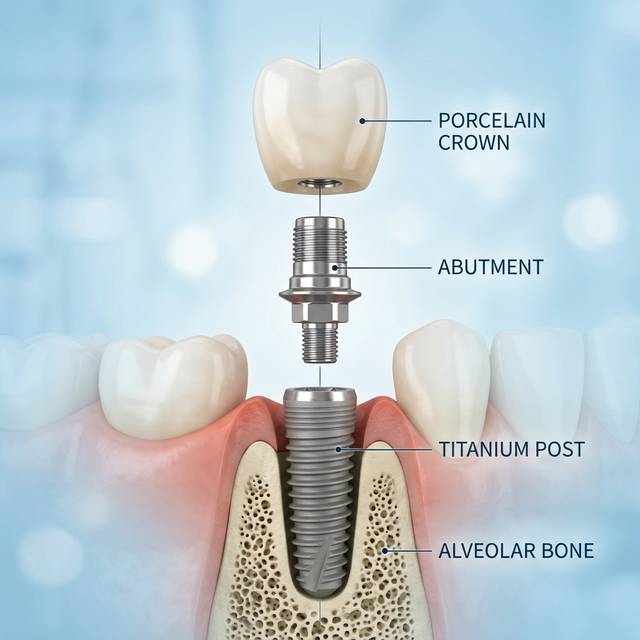
In 2026, the honest, out-the-door price for a single implant in the US averages $3,500 to $5,500. Remember, geography matters: expect closer to $5,000+ in coastal cities like Los Angeles or New York, but closer to $3,500 in the Midwest or South.
- The Prep (CBCT Scan & Extraction): $300 - $800. You absolutely need a 3D bone scan. If a clinic skips this to save money, run away.
- Part 1: The Titanium Post (The actual "implant"): $1,500 - $2,500. This goes into the jawbone.
- Part 2: The Abutment (The connector): $400 - $800. This connects the post to your new tooth.
- Part 3: The Crown (The visible tooth): $1,200 - $1,800.
When getting quotes from dentists, always ask: "Is this the complete price including the post, abutment, crown, and 3D scan?"
7 Proven Ways to Reduce Implant Costs Without Insurance
1. Dental School Clinics (Save 40–60%, But Pay with Time)
This is the most legitimate way to get half-price implants safely in the US. You are treated by advanced dental students (often doctors getting their surgical specialty) under the strict supervision of expert professors.
- The Cost: $1,500–$2,500 out-the-door.
- The Catch: Be prepared to wait 3–6 months for an opening. Furthermore, a standard 1-hour appointment might take 3 hours because a professor must check and sign off on every single step.
2. The "Deferred Interest" Trap: CareCredit and Financing
Many clinics push CareCredit or similar medical cards. They offer 0% APR for 6 to 24 months.
🚨 CRITICAL WARNING: This is "deferred interest," not true 0% interest. If you finance $4,000 for 12 months and you still owe even $1 on month 13, they will charge you 26.99% interest retroactively on the entire $4,000 from day one. If you use financing, set up autopay so it is fully paid off before the promotional period ends.
3. In-House Dental Membership Plans
Dentists are tired of dealing with insurance companies too. Many now offer in-house discount plans: you pay an annual fee (usually $200-$400), and in exchange, you get free cleanings and an automatic 15–25% discount on all major procedures, including implants.
4. HSA and FSA Accounts (The IRS Loophole)
Dental implants are an IRS-approved qualified medical expense. If you have a High Deductible Health Plan, you can funnel money into a Health Savings Account (HSA) completely tax-free. If you are in the 24% tax bracket, paying for a $4,000 implant through an HSA essentially gives you a $960 discount from Uncle Sam.
5. Negotiate "Package Pricing"
Dentists have high fixed costs just to set up the surgical room. If you need two implants next to each other, it takes them barely any extra time to place the second one. Always ask for a discount for multiple implants done on the same day.
6. Dental Tourism (High Risk, High Reward)
Going to Mexico (like Los Algodones), Costa Rica, or Colombia can drop the price of a $4,000 implant to $900–$1,500.
The Catch: You must factor in flights and hotels, and you will need to make the trip twice (once for surgery, once for the crown 4 months later). You also lose your legal safety net if the implant fails. Only go to clinics that use globally recognized FDA-cleared brands (like Straumann or Nobel) so a local US dentist can fix it if something goes wrong.
7. State and Community Programs
Charity models exist, such as Donated Dental Services (DDS). However, the waitlists are often years long, and they prioritize the disabled or medically fragile. (Note: If you are very low-income, a handful of states offer limited Medicaid coverage for implants, but only for extreme medical necessity. See our Medicaid Dental Guide for state rules.)
Self-Pay Cost Summary (What to Expect)
Here is what the real-world math looks like for a patient who needs one implant and has zero insurance:
| Strategy | Estimated Out-of-Pocket Cost | The Trade-off |
|---|---|---|
| Standard Private Practice | $3,500–$5,500 | Fastest, most convenient, but most expensive |
| University Dental School | $1,500–$2,500 | Long waitlists, very long appointments |
| In-House Membership Plan | $2,800–$4,500 | Must pay $200-$400 upfront fee to join |
| HSA Tax Savings (24% Bracket) | $2,660–$4,180 (effective) | Requires having an HSA-eligible health plan |
| Dental Tourism (e.g., Mexico) | $900–$1,500 (plus travel) | Hard to get US dentists to handle complications |
Calculate your personalized cash estimate by using our Cost Calculator.
8 Strategies to Reduce Implant Cost Without Insurance
| # | Strategy | Typical Savings | How It Works |
|---|---|---|---|
| 1 | Dental school clinics | 40–60% off | Procedures performed by supervised dental residents at university clinics |
| 2 | Cash-pay / self-pay discount | 10–25% off | Many private practices offer reduced rates for cash/check payment upfront |
| 3 | HSA / FSA accounts | 20–35% effective savings | Tax-free dollars reduce your effective cost by your marginal tax rate |
| 4 | In-house dental membership plans | 15–30% off | Annual fee ($200–$400) covers cleanings + discounts on major procedures |
| 5 | 0% APR financing (CareCredit, Proceed, LendingClub) | $0 savings but spreads cost | 12–24 month interest-free periods; pay $200–$400/month instead of lump sum |
| 6 | Value-tier implant brands | 30–50% off | Korean brands (Osstem, Dentium) cost practices $50–$150 per fixture vs $300–$500 for premium |
| 7 | Dental tourism (Mexico, Costa Rica, Colombia) | 50–75% off | Board-certified clinics in border cities; includes travel costs in savings calculation |
| 8 | Clinical trials | Free or near-free | University research studies testing new implant materials/techniques; limited availability |
For detailed cost breakdowns and city-by-city pricing: Complete cost guide → | Affordable options guide →
Dental School Clinics: Your Best Option for Quality + Savings
Dental school clinics consistently offer the best combination of quality care and affordability. Here is what to know:
- Savings: 40–60% lower than private practice averages. A single implant that costs $4,500 privately may cost $1,800–$2,500 at a dental school.
- Quality: All procedures are supervised by experienced faculty (board-certified specialists). The supervising surgeon approves each surgical step before, during, and after the procedure.
- Tradeoff: Appointments take longer (2–3× as long) due to teaching/learning process. Scheduling may be less flexible.
- Wait times: Popular programs have 3–6 month wait lists. Apply early.
Accredited Dental Schools with Implant Programs (2026)
- NYU College of Dentistry — New York, NY
- UCLA School of Dentistry — Los Angeles, CA
- University of Michigan School of Dentistry — Ann Arbor, MI
- University of Pennsylvania School of Dental Medicine — Philadelphia, PA
- Loma Linda University School of Dentistry — Loma Linda, CA
- UT Health San Antonio School of Dentistry — San Antonio, TX
Find more programs: Complete dental school directory →
HSA and FSA: The Tax-Free Strategy Most People Miss
If you have access to a Health Savings Account (HSA) or Flexible Spending Account (FSA) through your employer, dental implants are an eligible expense:
- HSA: Funds roll over year to year. You can save pre-tax money over multiple years to cover a large implant cost. 2026 limit: $4,300 (individual) / $8,550 (family).
- FSA: "Use it or lose it" within the plan year. 2026 limit: $3,300. Good for planned procedures within the calendar year.
- Effective savings: If your marginal tax rate is 32% (federal + state), paying $5,000 from an HSA saves you $1,600 in taxes — effectively reducing your cost to $3,400.
Pro tip: Many families use a strategy of maximizing HSA contributions for 2–3 years before a planned implant procedure, building up a tax-free fund specifically for dental work.
What About Dental Discount Plans?
Dental discount plans (also called dental savings plans) are not insurance — they are membership programs that provide negotiated discounts at participating dentists:
- Cost: $80–$200/year individual, $150–$400/year family
- Implant discount: Typically 15–30% off standard fees
- No waiting period: Unlike insurance, you can use the plan immediately
- No annual maximum: Unlike insurance ($1,000–$2,500 cap), discount plans have no spending limit
- Major providers: DentalPlans.com, Careington, Cigna Dental Savings
Worth it? For a single implant, a discount plan typically saves $800–$1,500 on the procedure. At $150/year for the membership, the return on investment is strong. However, verify that your chosen dentist participates before enrolling.
Financing: Monthly Payment Options
| Provider | 0% APR Period | Credit Score Needed | Monthly Payment Example ($4,500 implant) |
|---|---|---|---|
| CareCredit | 6, 12, 18, or 24 months | 620+ | $188–$375/month (12–24 months) |
| Proceed Finance | 6 or 12 months | 600+ | $375/month (12 months) |
| LendingClub | 12–24 months (select plans) | 660+ | $188–$375/month |
| In-house financing | Varies by practice | Often no credit check | Varies; typically 3–12 months |
Warning: If you do not pay off the balance within the promotional 0% APR period, retroactive interest (often 26–29% APR) may be charged on the entire original balance. Always set up automatic payments to clear the balance before the promotional period ends.
Model your payments: Financing calculator →