Dental Implant Pain: What It Actually Feels Like
Dental implant pain is typically rated 3–4 out of 10 by patients during recovery — most describe it as less painful than a tooth extraction. During surgery, local anesthesia ensures zero pain; sedation options (oral, IV, general) are available for anxious patients. Post-operative discomfort peaks at 24–48 hours and is managed with prescribed or OTC pain medication. Most patients return to work within 1–2 days. Severe pain beyond 5 days may indicate a complication requiring immediate attention.
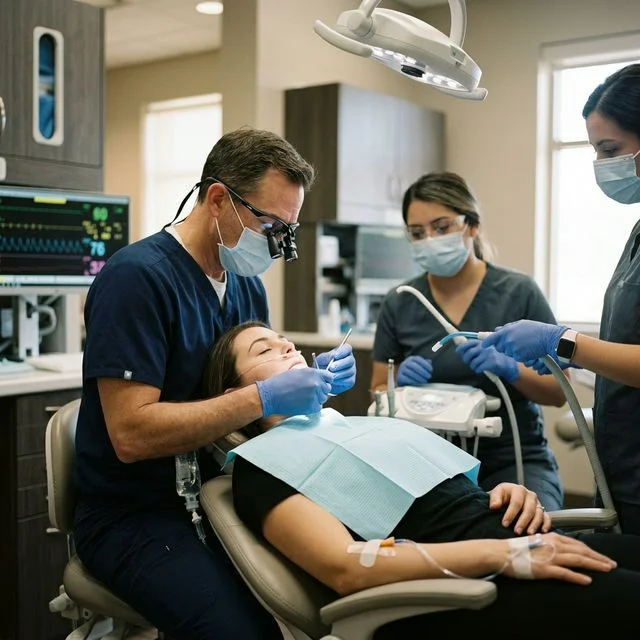
The #1 Fear: "Will I Feel the Drill?"
If the thought of a titanium screw being placed into your jaw makes your palms sweat, you are completely normal. It sounds medieval. But here is the objective, medical reality: The surgery itself is completely painless.
Why? Because the jawbone itself does not have nerve endings the way a tooth does. Once the local anesthesia numbs your gum tissue, your brain cannot register sharp pain in that area.
What you will feel is pressure and vibration. You will feel the doctor pushing, and you will feel a deep humming vibration, but no sharp pain. If you feel even a twinge of sharpness, you simply raise your left hand, and the doctor will immediately stop and give you more numbing medicine.
The Recovery: What It Actually Feels Like (Day by Day)
The part most people actually dread is what happens after the numbness wears off. Based on tracking thousands of patient recoveries, getting a single dental implant is usually less painful than getting a wisdom tooth pulled.

Here is your realistic, day-by-day survival guide:
Day 1: The "Throb"
About 2 to 4 hours after you leave the clinic, the anesthesia will wear off. You will feel a deep, dull, throbbing ache—similar to a bad bruise. This is the hardest day. The secret: Take your Ibuprofen before the numbness fully wears off to stay ahead of the pain.
Days 2 to 3: The "Swelling Peak"
The sharp throbbing usually fades into a stiff, sore feeling. Your cheek or lip will likely swell up, and you might see some bruising. The swelling looks worse than it feels. You will be living on mashed potatoes, smoothies, and scrambled eggs.
Days 4 to 5: The "Turning Point"
You should wake up feeling noticeably better. The swelling starts to go down, and you can usually switch from prescription painkillers to just occasional Tylenol or Advil.
Days 6 to 7: Finding Normal
By the end of the first week, the pain is usually gone, replaced by a mild tenderness if you press on the area. You can start chewing soft foods on the opposite side of your mouth.
The "Big Gun" Painkillers: You Probably Won't Need Them
Patients often assume they need strong narcotics (like Vicodin or Oxycodone) to survive implant surgery. In 2026, most top oral surgeons actively discourage this.
Clinical studies show that the absolute most effective medication for post-implant pain isn't a narcotic—it is Ibuprofen (Advil/Motrin). Because the pain is caused by inflammation, an anti-inflammatory like Ibuprofen targets the root cause, whereas narcotics just mask it (while making you nauseous).
A standard protocol is alternating 600mg of Ibuprofen and 500mg of Tylenol every 4 hours for the first 48 hours.
Too Anxious to Sit in the Chair? (Sedation Options)
If reading this is still making your heart race, don't muscle through it. Tell your dentist you have severe anxiety. You have excellent options:
- "Laughing Gas" (Nitrous Oxide): Takes the edge off, makes you feel floaty and relaxed. Wears off instantly so you can drive yourself home.
- Oral Sedation (A pill): You take a prescription pill (like Halcion) an hour before surgery. You will be awake, but extremely drowsy and relaxed. You will need a driver.
- IV Sedation ("Twilight Sleep"): This is the gold standard for high-anxiety patients. Medication is delivered through an IV. Technically you aren't fully unconscious, but you will feel like you took a 10-minute nap and woke up with the surgery completely finished. You will have zero memory of the sounds or sensations.
When to Call the Doctor (Red Flags)
Normal healing gets slightly better every single day after Day 3. You need to call your surgical team immediately if you experience:
- Pain that suddenly gets WORSE after day 4 or 5 (This is the #1 warning sign of an infection)
- A high fever (over 101°F)
- Pus or a foul, salty taste coming from the implant site
- Numbness in your chin or lip that doesn't wear off after 24 hours
Don't panic—infections are very rare with modern sterile techniques, but catching them early is the key to saving the implant.
Pain Scale: How Dental Implants Compare to Other Procedures
The #1 question patients ask: "How much does it hurt?" Here is how dental implant pain compares to other dental and medical procedures on a 0–10 scale:
| Procedure | Pain Rating (0–10) | Notes |
|---|---|---|
| Dental implant surgery | 0 (during) / 3–4 (after) | Local anesthesia eliminates surgical pain; post-op is mild |
| Simple tooth extraction | 0 (during) / 3–5 (after) | Similar or slightly more uncomfortable than implant |
| Wisdom tooth removal | 0 (during) / 5–7 (after) | More invasive, more swelling, longer recovery |
| Root canal | 0–2 (during) / 2–4 (after) | Comparable to implant; often less post-op pain |
| Bone grafting (for implant) | 0 (during) / 4–6 (after) | Adds discomfort if needed alongside implant placement |
| Full-arch All-on-4 surgery | 0 (during) / 5–7 (after) | More extensive; higher initial discomfort, longer recovery |
Key takeaway: Most patients say, "It wasn't as bad as I expected." The anticipatory anxiety before the procedure is typically worse than the actual pain experienced.
Day-by-Day Recovery and Pain Timeline
| Day | Pain Level | What to Expect | What to Do |
|---|---|---|---|
| Day 0 (surgery day) | 0–2/10 | Numbness from anesthesia; minimal pain until it wears off (3–5 hours) | Start pain meds before numbness fades; ice 15 min on/15 min off; rest |
| Day 1 | 3–5/10 | Peak discomfort begins; mild swelling; slight bleeding possible | Ibuprofen + acetaminophen rotation; ice pack; soft foods; elevated sleeping |
| Day 2 | 3–4/10 | Swelling peaks (this is normal); bruising may appear | Continue medication; switch to warm compress after 48 hours; gentle salt rinse |
| Days 3–5 | 2–3/10 | Significant improvement; swelling decreasing; bleeding stopped | Transition to OTC pain relievers only; resume gentle oral hygiene |
| Days 6–10 | 0–2/10 | Mild tenderness when chewing; suture removal (if non-dissolvable) | Return to normal activities; still soft foods near implant site |
| Weeks 2–6 | 0/10 | Soft tissue fully healed; site feels normal | Normal diet (avoid extremely hard foods at site); routine hygiene |
Important: If pain increases after Day 3 (instead of decreasing), or you develop fever, pus, or a foul taste — contact your dentist immediately. This is not normal and may indicate infection.
Sedation Options: Managing Anxiety and Pain During Surgery
| Sedation Level | Method | Awareness | Cost | Best For |
|---|---|---|---|---|
| Local anesthesia only | Injection at implant site | Fully awake; zero pain; feel pressure only | Included in implant fee | Patients with low anxiety; single implant procedures |
| Nitrous oxide ("laughing gas") | Inhaled through nasal mask | Awake but relaxed; mild euphoria | $50–$200 | Mild anxiety; wears off in minutes after mask removed |
| Oral sedation | Prescribed pill (e.g., diazepam) taken before appointment | Drowsy; may not remember procedure | $150–$500 | Moderate anxiety; need a driver home |
| IV sedation ("twilight") | Medication through IV line | Semi-conscious; no memory of procedure | $250–$900 | High anxiety; multiple implants or complex procedures |
| General anesthesia | Fully unconscious (hospital or surgical center) | Completely asleep | $500–$3,000+ | Severe dental phobia; full-arch surgery; medically necessary |
Most common choice: Local anesthesia + nitrous oxide is the standard for single implant placement. IV sedation is recommended for anxious patients or procedures involving multiple implants, bone grafting, or All-on-4 surgery.
Pain Management: Medication Guide
Recommended Pain Relief Protocol
Research supports combining ibuprofen and acetaminophen for dental pain — this combination is as effective as opioids for most patients, with fewer side effects:
- Step 1 — Before numbness fades: Take 600mg ibuprofen (Advil/Motrin) within 1 hour after surgery, before the anesthesia wears off. This "preemptive" approach prevents pain from establishing.
- Step 2 — Alternating schedule (Days 1–3): Alternate 600mg ibuprofen every 6 hours with 500–1000mg acetaminophen (Tylenol) every 6 hours — staggered 3 hours apart. This provides continuous coverage from two different mechanisms.
- Step 3 — Taper down (Days 4–7): Switch to ibuprofen only as needed. Most patients discontinue all pain medication by Day 5–7.
If Prescription Pain Medication Is Needed
Your surgeon may prescribe a short course (3–5 days) of stronger medication for more extensive procedures (bone grafting, multiple implants, full-arch surgery). Follow dosing strictly and transition to OTC medication as soon as pain permits.
Natural and Supportive Remedies
- Ice pack: 15 minutes on, 15 minutes off for the first 48 hours. This is the single most effective non-medication strategy for swelling and pain.
- Warm compress: Switch from ice to warm compresses after 48 hours to promote blood flow and healing.
- Salt water rinse: Start 24 hours after surgery. Gently rinse with warm salt water (½ teaspoon salt in 8 oz water) 3–4 times daily.
- Elevated sleeping: Sleep with 2–3 pillows or in a recliner for the first 2–3 nights. Elevation reduces blood flow to the head, minimizing swelling.
- Soft food diet: Yogurt, smoothies, mashed potatoes, scrambled eggs, soup (not hot). Avoid crunchy, spicy, or very hot foods for 10–14 days.
Warning Signs: When Pain Indicates a Problem
Some post-operative discomfort is normal, but certain symptoms require immediate attention:
| Symptom | Normal vs Abnormal | Action |
|---|---|---|
| Pain increasing after Day 3 | Abnormal — pain should be decreasing | Call dentist within 24 hours |
| Severe throbbing pain | Abnormal — may indicate infection or implant loosening | Call dentist immediately |
| Fever > 101°F (38.3°C) | Abnormal — possible infection | Call dentist immediately |
| Pus or foul taste/smell | Abnormal — infection | Call dentist immediately |
| Numbness lasting > 24 hours | Abnormal — possible nerve injury | Contact surgeon same day |
| Implant feels loose or wobbly | Abnormal — osseointegration failure | Call dentist immediately |
| Mild swelling (Days 1–3) | Normal — peaks at 48 hours | Ice pack, anti-inflammatory medication |
| Slight bleeding (Day 0–1) | Normal — should stop within 24 hours | Gentle gauze pressure for 30 minutes |
Learn more about potential complications: Implant failure rates and risk factors →