All-on-4 Dental Implants: Full-Arch Replacement Explained
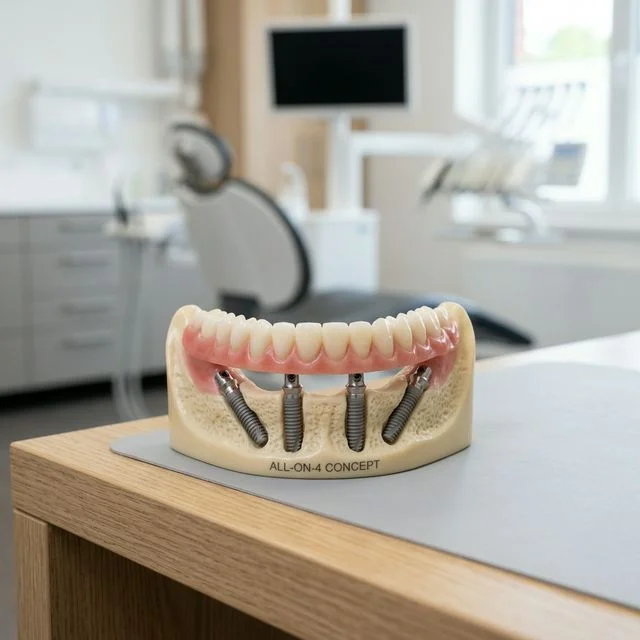
All-on-4 dental implants is a full-arch tooth replacement technique that uses just 4 strategically angled titanium implants to support a fixed bridge of 10–14 teeth. Developed by Dr. Paulo Maló, this approach costs $20,000–$35,000 per arch in 2026 (vs $60,000–$90,000 for individual implants) and often allows same-day temporary teeth. A 2026 large-scale analysis found a 97.83% clinical success rate. Two posterior implants are placed at 30–45° angles to maximize bone contact, frequently eliminating the need for bone grafting.
The "Magic" of All-on-4: Why You Probably Don't Need Bone Grafting
If you've been told you have severe bone loss and need expensive, painful bone grafting before getting implants, take a deep breath. All-on-4 might be your shortcut.
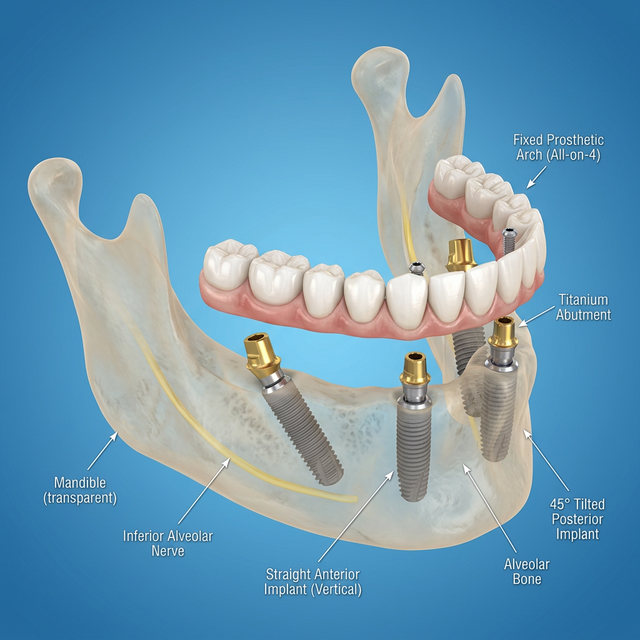
Unlike traditional methods that plant 6 to 8 screws straight down into your jaw, All-on-4 uses a brilliant engineering trick: the two back implants are tilted at a 45-degree angle. This tilt allows the implants to anchor into deeper, denser bone further forward in your jaw, completely bypassing the areas where your bone has eroded.
The result? You get a full, permanent set of upper or lower teeth anchored on just 4 titanium posts, usually without a single bone graft, often in just one day.
The $14,999 Pricing Trap: Temporary vs. Permanent Teeth
You have probably seen billboards or Facebook ads screaming: "Full Mouth Dental Implants for $14,999!"
🚨 CRITICAL WARNING: Here is the catch they aren't telling you.
That $14,999 almost always covers the surgery and a temporary acrylic (plastic) bridge. It's essentially a high-end denture bolted to your new implants. It looks okay, but acrylic is porous. Within 6 to 12 months, it will absorb stains, hold onto odors, and eventually wear down or break if you eat hard foods.
To get your permanent, rock-solid Zirconia teeth (which won't stain and can actually bite an apple without breaking), the clinic will suddenly hand you a "Phase 2" bill for another $10,000 to $15,000.
When getting quotes, ALWAYS ask the dentist directly: "Does this price include the FINAL Zirconia bridge, or just the temporary acrylic one?" The honest, out-the-door price for a complete, final Zirconia All-on-4 arch in 2026 usually ranges from $25,000 to $35,000.
All-on-4 vs. All-on-6 vs. Snap-In Dentures: A Realistic Comparison
Don't be overwhelmed by the numbers. Here is the honest breakdown of your choices:
| Treatment | What It Is | Honest Cost (Per Arch) | The Verdict |
|---|---|---|---|
| Snap-In Dentures | Dentures that click onto 2-4 implants. You still take them out at night. | $5,000 – $10,000 | The Budget Choice. Vastly better than traditional dentures, but they still have a bit of "wiggle" and must be removed daily. |
| All-on-4 | 4 implants permanently holding a full bridge of teeth. Never comes out. | $25,000 – $35,000 | The Sweet Spot. Best balance of permanent stability and cost. Ideal if you have bone loss. |
| All-on-6 | 6 implants holding the bridge. Even more stable. | $30,000 – $40,000+ | The Heavy-Duty Option. Great if you have a very strong bite or plenty of jawbone, but often unnecessary for the average patient. |
Calculate your specific scenario with our Full Mouth Cost Calculator.
The Procedure: What "Teeth in a Day" Really Means
Yes, you leave the clinic with teeth on the same day as your surgery. However, they are not your final teeth.
Step 1: Surgery Day (The "Teeth in a Day" part)
- You will likely be under IV sedation (asleep and feeling nothing).
- The doctor extracts your failing teeth, places the 4 implants, and attaches your temporary acrylic bridge.
- You wake up with a new smile, but you must stick to a strict soft-food diet (think scrambled eggs, protein shakes, and mashed potatoes) so you don't disturb the healing implants.
Step 2: The Healing Phase (3 to 6 Months)
This is when the real magic happens. The titanium posts will literally fuse to your jawbone over the coming months. You will wear your temporary bridge during this entire period.
Step 3: Getting Your Final Teeth
Once your jaw has completely healed and the implants are locked in like steel girders, the doctor removes the temporary plastic teeth and screws in your permanent Zirconia bridge. Now, you can eat steak.
Post-Surgery Survival Guide: The Waterpik Rule
Many patients think, "Great! Fake teeth mean I never have to brush or floss again."
Wrong. If you do not keep the tiny gap between your gums and the All-on-4 bridge clean, bacteria will build up, cause "peri-implantitis" (implant gum disease), and your $30,000 investment will literally fall out of your head.
- Buy a Water Flosser (Waterpik) immediately. You must use it every single day to blast food particles out from under the bridge.
- Use a soft-bristled brush to clean the bridge itself.
- Get professional cleanings 2-3 times a year. Only a hygienist can use special tools to clean around titanium implants without scratching them.
Red Flags: Who Should NOT Get All-on-4 Right Now?
If a clinic tells you "everyone is a candidate," get a second opinion. You should pump the brakes if:
- Your Diabetes is Uncontrolled: If your HbA1c is over 9%, your body simply cannot heal properly. The implants are highly likely to become infected and fail. Get your blood sugar down first.
- You are a Heavy Smoker: Smoking drastically reduces blood flow to your gums. Smoking more than half a pack a day doubles or triples your risk of implant failure.
- You Only Need 2 or 3 Teeth Replaced: All-on-4 requires extracting ALL the teeth in that arch. If you still have mostly healthy teeth, do not let a dentist pull them just to sell you a big package. Get individual implants or a small bridge instead.
All-on-4 Success Rates: What the Clinical Data Shows
All-on-4 is one of the most extensively studied full-arch restoration protocols in implant dentistry. Here is what the data shows across different timeframes:
| Timeframe | Success Rate | Source | Notes |
|---|---|---|---|
| Overall clinical | 97.83% | 2026 large-scale analysis | Only 2.17% implant failure rate across all cases |
| 5-year | 95–98.8% | Multiple studies | Higher in mandible (lower jaw) than maxilla (upper jaw) |
| 10-year | 92–97% | Long-term cohort studies | Requires consistent maintenance |
| 20-year | ~92% | Longest available follow-up | With proper maintenance and prosthetic replacements |
| Lower jaw (mandible) | 98.8% | Cumulative prosthetic survival | Denser bone = higher success |
| Upper jaw (maxilla) | 95–97% | Cumulative prosthetic survival | Softer bone = slightly lower success |
Risk factors for failure: Smoking (most significant), prior implant failure, uncontrolled diabetes, severe bruxism (teeth grinding), and poor oral hygiene maintenance.
All-on-4 Cost Breakdown (2026)
| Component | Cost Range | Notes |
|---|---|---|
| All-on-4 per arch (acrylic) | $20,000–$26,000 | Standard acrylic or composite prosthesis |
| All-on-4 per arch (porcelain) | $26,000–$32,000 | Metal-reinforced porcelain prosthesis |
| All-on-4 per arch (zirconia) | $35,000–$50,000+ | Premium monolithic zirconia — most durable and aesthetic |
| Full mouth (both arches) | $40,000–$120,000+ | Depends on material choice for each arch |
| Bone grafting (if needed) | $500–$10,000+ | Rarely needed — All-on-4 is designed to avoid grafting |
| Extractions | $75–$650 per tooth | Often included in package pricing |
| Temporary prosthesis | $800–$1,500 per arch | Worn during 3–6 month healing period |
Insurance: Most dental insurance plans cover a small portion ($1,000–$2,500 annually). Some Medicare Advantage plans offer partial coverage. Medicare coverage details →
Model your payment plan: Financing calculator | Cost by city: City-by-city cost guide
All-on-4 vs All-on-6: Which Is Right for You?
| Factor | All-on-4 | All-on-6 |
|---|---|---|
| Number of implants | 4 per arch | 6 per arch |
| 2026 Cost | $20,000–$35,000/arch | $24,000–$40,000/arch |
| Bone requirements | Lower — angled implants use denser anterior bone | Higher — needs more bone volume for 6 vertical placements |
| Bone grafting needed? | Rarely (one of the key advantages) | More frequently, especially with bone loss |
| Stability | Excellent | Superior — load distributed across 6 points |
| Surgery complexity | Shorter, less invasive | Longer surgery, more implant sites |
| Recovery time | Faster initial recovery | Slightly longer |
| Long-term durability | Excellent (15–20+ years) | Potentially superior (better load distribution reduces per-implant stress) |
| Best for | Patients with moderate bone loss, budget-conscious patients | Patients with good bone, heavy bite force, seeking maximum stability |
Bottom line: All-on-4 is the right choice for most patients because it reduces cost, surgical complexity, and bone grafting requirements. All-on-6 is recommended when maximum stability is needed (e.g., large jaw, heavy biter, sufficient bone). Your implant surgeon will recommend the optimal protocol based on your CBCT scan results.
The All-on-4 Procedure: Step by Step
- Consultation and digital planning (Week 1): CBCT 3D scan, medical history review, and digital treatment planning. AI-assisted software maps optimal implant positions based on your bone anatomy.
- Pre-surgery preparation: Impressions for your temporary prosthesis. Any dental clearances or medication adjustments.
- Surgery day (2–4 hours): Under IV sedation or general anesthesia, remaining teeth are extracted (if needed), 4 implants are placed (2 vertical anterior + 2 angled posterior at 30–45°), and a temporary fixed bridge is attached the same day. Most patients leave with functional temporary teeth.
- Initial healing (Weeks 1–6): Soft food diet. Mild swelling and discomfort for 3–7 days. Follow-up visits at week 1 and week 4.
- Osseointegration (3–6 months): Implants fuse with jawbone. You wear the temporary prosthesis during this period. Gradual return to normal diet.
- Final prosthesis (Month 4–6): Impressions are taken for your permanent zirconia, porcelain, or acrylic bridge. The final prosthesis is fabricated and permanently attached.
Full surgical walkthrough: Dental implant procedure guide →
Are You a Candidate for All-on-4?
Ideal Candidates
- Missing all or most teeth in one or both arches
- Currently wearing dentures and wanting a permanent solution
- Teeth failing due to severe decay or gum disease
- Moderate bone loss (All-on-4 is designed for this)
- Good overall health with controlled chronic conditions
- Non-smoker or willing to quit before and during healing
May Not Be Suitable If
- Only missing 1–3 teeth (single implants or bridges are better options → single tooth implant guide)
- Severe, uncontrolled diabetes (HbA1c > 8%)
- Active cancer treatment with head/neck radiation
- Long-term bisphosphonate use without medical clearance
- Insufficient bone AND unwilling to undergo zygomatic implant option
Not sure? Explore all your options: Implant alternatives guide | Implants vs dentures comparison
All-on-4 Prosthetic Material Options
| Material | Cost/Arch | Durability | Aesthetics | Weight | Maintenance |
|---|---|---|---|---|---|
| Acrylic (PMMA) | $20,000–$26,000 | 5–10 years | Good | Lightest | Prone to staining and chipping; more frequent replacement |
| Porcelain-fused-to-metal | $26,000–$32,000 | 10–15 years | Very good | Medium | Porcelain can chip; metal substructure visible if gums recede |
| Monolithic zirconia | $35,000–$50,000+ | 20+ years | Excellent | Heaviest | Most stain-resistant and chip-resistant; premium option |
Recommendation: If budget permits, monolithic zirconia is the best long-term investment — its 20+ year lifespan means you may never need a prosthetic replacement. Acrylic is a good starting option if you plan to upgrade later, as the implants themselves remain the same regardless of the prosthetic material attached to them.