Dental Implant Alternatives: Exploring Your Best Options
Dental implant alternatives include several tooth replacement options for patients who cannot or prefer not to get implants. The main alternatives are dental bridges ($1,500–$5,000, last 10–15 years), partial dentures ($500–$2,500, last 5–8 years), Maryland bridges ($1,500–$2,500, last 5–8 years), flipper teeth ($300–$500, temporary), and implant-supported dentures ($3,500–$30,000, last 15–20 years). Each option varies in cost, durability, comfort, and impact on adjacent teeth.
Understanding Your Choices: You Have Options
Losing a tooth—or being told you need to have one extracted—can feel overwhelming. It's completely normal to feel hesitant about dental implants, whether it's due to the cost, the idea of surgery, or simply the time involved.
The most important thing to know is this: implants are not your only choice, and you don't have to rush into a decision. Dentistry has several reliable, well-tested alternatives that can help you smile, speak, and eat with confidence again. Let's explore the most common options so you can find what fits your lifestyle and budget.
| Option | Estimated Cost | Expected Lifespan | Impact on Other Teeth |
|---|---|---|---|
| Dental implant | $3,000–$5,500 | 25+ years | None |
| Dental bridge (3-unit) | $1,500–$5,000 | 10–15 years | Requires reshaping 2 adjacent teeth |
| Partial denture | $500–$2,500 | 5–8 years | Minimal (uses clasps) |
| Maryland bridge | $1,500–$2,500 | 5–8 years | Minimal (bonded to the back) |
| Flipper tooth | $300–$500 | 1–2 years | None |
Dental Bridges: A Fast, Fixed Solution
If you're missing a single tooth and want something that feels permanent without undergoing surgery, a dental bridge is often the most recommended alternative. It firmly bridges the gap left by a missing tooth.

How It Works
Think of it literally as a bridge spanning a river. To hold the fake middle tooth (the pontic) securely in place, the two healthy teeth on either side of the gap are given crowns. These three pieces are fused together and cemented firmly in your mouth.
Why Patients Choose It
- ✓ Quick timeline: Usually completed in just two or three weeks.
- ✓ No surgery: Completely avoids bone drilling, grafting, or incisions.
- ✓ Stays securely in place: It's permanently cemented; no taking it out at night.
- ✓ Insurance friendly: Many dental plans cover a significant portion.
Things to Consider
- • Alters healthy teeth: The adjacent teeth must be shaved down to fit the crowns.
- • Cleaning requires care: You'll need to use special floss threaders to clean underneath the fake tooth.
- • Doesn't preserve bone: The jawbone where the tooth is missing may slowly shrink over time because there is no root stimulating it.
Removable Partial Dentures: The Budget-Friendly Choice
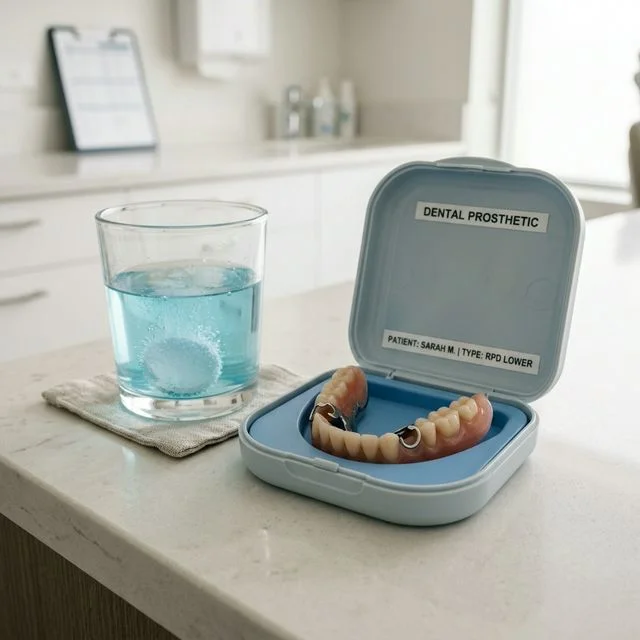
A partial denture is a removable appliance that clips onto your remaining natural teeth. It's an excellent choice if you need to replace multiple teeth across your mouth but are working with a strict budget, or if you prefer a non-invasive option.
Modern partials have come a long way. While traditional ones use a metal framework for durability, many patients now opt for flexible partials (like Valplast). These use soft, gum-colored nylon clasps instead of metal, making them much more comfortable, lightweight, and aesthetically pleasing.
The Main Benefit: They are much more affordable than implants or bridges, and they rarely require altering your remaining healthy teeth.
The Compromise: They are removable, meaning you have to take them out for daily cleaning. Some patients find the clasps slightly bulky at first or notice that they don't offer the exact same chewing strength as natural teeth.
Maryland Bridges: The Conservative Option for Front Teeth
If you're missing a front tooth and don't want your healthy neighboring teeth shaved down for a standard bridge, a Maryland bridge (also known as a resin-bonded bridge) might be a great compromise.
Instead of full crowns, this alternative uses a fake tooth with tiny metal or porcelain "wings." These wings are bonded secretly to the back of your neighboring teeth. It's a far less invasive procedure, preserving your natural smile while filling the gap beautifully.
Note: Maryland bridges are generally only recommended for front teeth, as they aren't strong enough to withstand the heavy chewing forces of your back molars.
Flipper Teeth: A Temporary Fix
A flipper tooth is a very lightweight, inexpensive removable partial denture. It's almost always used as a temporary cosmetic placeholder rather than a long-term solution.
For example, if you've just had a tooth extracted and are waiting for your gums to heal before getting an implant or bridge, your dentist might give you a flipper. It allows you to smile normally in public and at work, though you typically slip it out when eating tough foods to avoid breaking it.
Implant-Supported Dentures: The Middle Ground
If you are missing all your teeth on the upper or lower jaw, standard dentures can sometimes feel slippery or frustrating. Implant-supported dentures (often called "Snap-On dentures") offer a fantastic compromise between affordable traditional dentures and premium fixed full-arch implants.
By placing just two to four implants in the jaw, your removable denture can actually "snap" securely into place. This dramatically improves stability—no more worrying about your teeth slipping while you laugh, sneeze, or eat—while remaining much more affordable than a permanent fixed bridge.
Looking at the Big Picture: Value Over Time
When making your decision, it helps to think not just about today, but five, ten, or twenty years down the road. While alternatives like bridges and dentures have a lower upfront cost, they typically need to be replaced periodically (every 5 to 15 years).
An implant is an investment: while the initial cost is higher and the process takes longer, it can last a lifetime with good care, meaning it often becomes the most cost-effective choice in the long run.
Ultimately, your dentist's job is not to push you into the most expensive option. Their role is to help you find the solution that brings you peace of mind, fits your budget comfortably, and lets you enjoy your daily life without worry. Take your time, ask questions, and choose the path that feels right for you.
Compare Your Options
Want to see the math? Try our interactive calculator to model the costs over time.
Implant vs Alternatives CalculatorComplete Comparison: All Tooth Replacement Options
| Option | 2026 Cost | Lifespan | Surgery? | Bone Preservation | Aesthetics | Best For |
|---|---|---|---|---|---|---|
| Single implant | $2,500–$6,000 | 25+ years | Yes | Yes | Excellent | Best long-term solution, preserves bone |
| 3-unit bridge | $1,500–$5,000 | 10–15 years | No | No | Very good | Faster, no surgery, good if adjacent teeth need crowns |
| Maryland bridge | $1,500–$2,500 | 5–8 years | No | No | Good | Front teeth replacement, minimal prep of adjacent teeth |
| Removable partial denture | $500–$2,500 | 5–8 years | No | No | Fair to good | Budget option, multiple missing teeth, easy adjustment |
| Flipper (temporary partial) | $300–$500 | 6–12 months | No | No | Fair | Temporary solution while waiting for implant/bridge |
| Full denture | $1,000–$3,000 | 5–10 years | No | No | Fair | Full arch, lowest cost for complete tooth loss |
| Implant-supported denture | $3,500–$30,000 | 15–20 years | Yes | Yes | Very good | Full arch, much better stability than regular dentures |
| All-on-4 | $20,000–$35,000/arch | 20+ years | Yes | Yes | Excellent | Full arch fixed restoration, permanent teeth |
When Each Alternative Is the Right Choice
Choose a Dental Bridge If
- You want a non-surgical, permanent (cemented) solution
- The adjacent teeth already need crowns or have large fillings
- You need faster results (2–3 weeks vs 3–6 months for implants)
- Budget is a concern but you want a fixed restoration
Choose a Removable Partial Denture If
- You are missing multiple teeth in different areas
- You need the most affordable option
- You cannot undergo surgery due to health conditions
- You need an interim solution while planning for implants later
Choose a Flipper If
- You need a temporary cosmetic solution immediately after extraction
- You are waiting for an implant site to heal before permanent placement
- You need the lowest-cost option for a short-term gap
Choose Implant-Supported Dentures If
- You currently wear dentures but are frustrated with looseness and discomfort
- You want significantly better stability than regular dentures
- Budget is between conventional dentures and All-on-4
- You prefer a removable option that you clean outside your mouth
For full-arch options: All-on-4 guide | Implants vs dentures comparison | Mini implants for denture stabilization
The Long-Term Cost Reality
The cheapest option upfront is not always the cheapest over 20 years. Here is the projected 20-year total cost of ownership:
| Option | Initial Cost | Replacements Needed | 20-Year Total |
|---|---|---|---|
| Single implant | $3,500 | Crown replacement once (~$1,200) | $4,700 |
| 3-unit bridge | $3,000 | Full replacement once ($3,000) | $6,000 |
| Partial denture | $1,500 | 2–3 replacements ($1,500 each) + adhesive/relines | $5,500–$6,000 |
| Full denture | $2,000 | 2 replacements ($2,000 each) + relines | $7,000–$8,000 |
Conclusion: A single implant, despite the higher upfront cost, is often the least expensive option over 20 years — and it is the only option that preserves your jawbone. Full cost analysis →