Dental Implants for Seniors: What Patients 65+ Need to Know
Dental implants for seniors are titanium or zirconia tooth replacements designed for patients aged 65 and older. Despite common misconceptions, age alone is not a disqualifier — success rates for seniors remain 94–98% when bone density is adequate. A 2025 systematic review and meta-analysis found that patients aged 75+ had a 96.8% five-year survival rate, while those aged 65–75 had a 92.1% five-year survival rate — confirming that older age does not reduce implant success. Key considerations include Medicare coverage gaps (Original Medicare does not cover dental implants in 2026), bone density assessment via CBCT scan, medication interactions with bisphosphonates and blood thinners, and fixed-income financing strategies.
Are You Too Old for Dental Implants? (The Honest Answer)

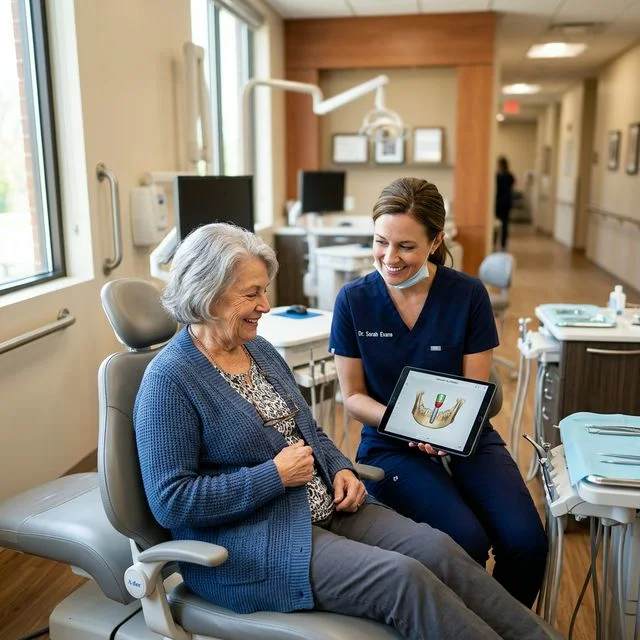
The short answer: no. Age alone is not a disqualifier for dental implants. Research published in the International Journal of Oral and Maxillofacial Implants (2024 update) shows that patients aged 65–85 achieve 94–98% implant success rates, which is virtually identical to younger adults.
What doctors actually look at isn't the year you were born, but your overall health profile:
- Bone density (The #1 hurdle): Before anything else, the dentist will take a 3D X-ray (CBCT scan). This measures if your jawbone is thick and deep enough to hold the titanium post securely.
- Chronic conditions: Well-controlled diabetes (HbA1c under 8%), hypertension, and even osteoporosis do not disqualify you. The key is "well-controlled."
- Healing speed: Yes, as a senior, you might take an extra 2–4 weeks to fully heal, but the final, permanent result is just as strong.
Medicare, Insurance, and the "Hidden Costs" (2026 Update)
Let's talk about the biggest stressor: the money. Original Medicare (Parts A & B) does not cover dental implants. It only kicks in for rare cases like jaw reconstruction after a tumor or accident.
What about $399 Implant Ads? (The Pricing Trap)
You've likely seen ads for drastically discounted implants. When a clinic advertises a $900 or $1,500 implant, ask them this specific question: "Does that price include the abutment (the connector) and the final crown (the tooth you chew with)?"
Usually, it doesn't. A complete, single dental implant in the US (in 2026) averages between $3,500 and $5,500 total depending on your city. The breakdown looks like this:
- CT Scan & Exam: $250 - $600
- The Titanium Implant (Surgery): $1,500 - $2,500
- The Abutment (Connector): $400 - $800
- The Final Crown: $1,200 - $1,800
How to Actually Save Money
Since Medicare won't help much, here are the real ways seniors are affording this:
- Medicare Advantage (Part C) Dental Riders: Some 2026 plans offer $1,000–$3,000 annually. This won't cover the whole thing, but it takes a significant bite out of the cost.
- University Dental Schools: If you have time, universities (where students work under expert specialist supervision) charge 40–60% less—often bringing a $4,500 implant down to $2,000.
- CareCredit: Most reputable clinics offer 12-24 months of 0% interest financing. For a $4,000 implant, that's about $166/month with no interest.
Will It Hurt? The Truth About the Surgery
Getting a screw put into your jaw sounds terrifying. But because the jawbone itself doesn't have nerve endings, and because modern local anesthesia is excellent, the surgery itself is often completely painless.
Most patients say the recovery is actually easier than getting a tooth pulled. Here is what the first few days actually feel like:
- Days 1-2: It feels like a dull ache or pressure, similar to a deep bruise. Your cheek will likely swell. Alternating ibuprofen and Tylenol is usually enough to manage it perfectly.
- Days 3-5: The swelling peaks and starts to fade. You'll be eating very soft foods (mashed potatoes, smoothies, scrambled eggs).
- The "Waiting Period" (4-6 Months): The gums heal over quickly. The real work happens underneath, where the bone is slowly fusing to the titanium (osseointegration). You won't feel this happening.
What If You Have Osteoporosis or Take Certain Medications?
Always bring your current pill bottles to your consultation. Never stop taking your medication on your own, but be aware of these common senior medication interactions:
- Osteoporosis Meds (Fosamax, Boniva): If you take oral "bisphosphonates," there is a very rare (about 0.1–0.2%, according to ADA data) chance of delayed jaw healing. Your dentist might coordinate with your doctor to take a temporary "drug holiday" for a few months before surgery.
- Blood Thinners (Xarelto, Eliquis, Warfarin): Do not stop these! Your oral surgeon is trained to handle the bleeding risk during surgery without asking you to risk a stroke.
How to Avoid Bad Doctors and "Implant Mills"
Because dental implants are highly profitable, some clinics run like assembly lines. If you are a senior with potentially thinner bone or health conditions, do not go to the cheapest doctor.
Here is exactly how to verify you are in safe hands:
- Look for Board Certification: Ask if the doctor performing the surgery is a Board Certified Periodontist or a Board Certified Oral & Maxillofacial Surgeon (OMS). General dentists can legally place implants, but specialists spend an extra 3-4 years doing nothing but complex surgeries.
- Ask about "Failure Policies": Even with a 95% success rate, implants can fail to fuse properly. A trustworthy clinic will tell you exactly what happens next (usually, they remove it, let it heal, and replace it at no or minimal extra charge). If they dodge the question, leave.
Use our Insurance Savings Calculator to estimate your out-of-pocket costs, or read our guide on Dental Implants After Bone Loss if your dentist mentioned you need a graft.
Success Rates by Age Group: What the Clinical Data Shows
One of the most common concerns among seniors is whether their age makes dental implants too risky. The clinical evidence overwhelmingly says no. Here is what peer-reviewed studies report for different age brackets:
| Age Group | 1-Year Survival Rate | 5-Year Survival Rate | 10-Year Survival Rate | Source |
|---|---|---|---|---|
| All ages (baseline) | 97.7% | 96.2% | 91.2% | Meta-analysis of elderly implant studies (PubMed/NIH) |
| 65–75 years | ~97% | 92.1% | ~91% | 2025 systematic review and meta-analysis (PubMed) |
| 75+ years | ~98% | 96.8% | N/A (insufficient follow-up) | 2025 systematic review: higher than 65–75 group |
| 70+ years (overall) | — | 94.8% | — | 2024 retrospective analysis |
Key takeaway: A June 2025 systematic review found that patients over 75 actually had higher five-year survival rates (96.8%) than the 65–75 age group (92.1%). No significant difference in success rates was observed between these groups. This directly challenges the assumption that older patients are inherently higher-risk candidates.
The clinical evidence consistently shows that overall health and bone quality — not chronological age — are the true determinants of implant success. Healthy seniors with adequate bone density achieve outcomes comparable to much younger patients. A thorough pre-surgical CBCT assessment of bone density remains the single most important predictive factor.
Bone Density Assessment: The Real Deciding Factor
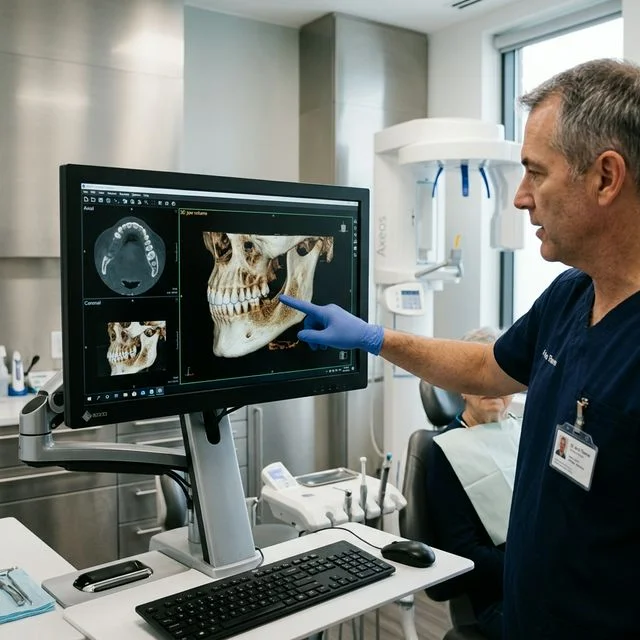
If you are over 65 and considering dental implants, the single most important medical evaluation is your jawbone density. Your dentist will order a Cone-Beam Computed Tomography (CBCT) scan — a 3D imaging technology that maps your jawbone volume, density, and the precise location of nerves and sinuses.
What If Your Bone Density Is Low?
Low bone density — whether from aging, osteoporosis, or long-term denture wear — does not automatically disqualify you from implants. Modern solutions include:
- Bone grafting: Synthetic or donor bone material is placed in the jaw 3–6 months before implant placement to rebuild lost volume. Success rates for grafted sites exceed 90%.
- Shorter, wider implants: Specialized implant designs (e.g., 6mm short implants) can achieve stability in reduced bone height without grafting.
- Zygomatic implants: For severe upper jaw bone loss, implants anchored in the cheekbone (zygoma) bypass the need for bone grafts entirely. Learn more about zygomatic implants →
- All-on-4 protocol: Uses only 4 strategically angled implants to support a full arch, minimizing bone requirements. Learn more about All-on-4 implants →
Modern bone grafting procedures have success rates of 90–98%, and implant success in grafted bone reaches 94–97% at 5 years — meaning bone loss is a solvable problem, not a disqualifier.
Medicare Coverage for Dental Implants in 2026: The Full Picture
One of the most frustrating realities for seniors is that Original Medicare (Parts A and B) does not cover dental implants in 2026. This policy has remained unchanged, and the Centers for Medicare & Medicaid Services (CMS) has confirmed it will not expand dental coverage in the 2026 Physician Fee Schedule.
When Original Medicare Does Cover Dental Work
There are narrow exceptions where Medicare may cover dental services that are "inextricably linked to and substantially related to" another covered medical procedure:
- Dental clearance before organ transplants
- Dental treatment related to cardiac valve replacement
- Dental care connected to head and neck cancer treatment (radiation therapy)
Important: Even in these cases, Medicare covers the hospitalization and medical care — not the dental implant procedure itself. Starting July 1, 2025, providers must use a specific KX modifier and submit an ICD-10 code on dental claims (837D or 2024 ADA claim form) to bill for medically necessary dental services. Claims received without the KX modifier may be denied by Medicare Administrative Contractors (MACs).
Medicare Advantage (Part C): Your Best Option
If you have a Medicare Advantage plan (Part C), you may have partial dental implant coverage. Key facts for 2026:
- 97% of Medicare Advantage plans offer some form of dental benefit (per ADA data)
- Coverage varies widely — annual maximums typically range from $1,000 to $2,000
- Some plans require implants to be deemed "medically necessary" for coverage
- 2026 changes: Some plans are introducing coinsurance for non-preventive services or reducing overall dental coverage — review your plan's Annual Notice of Changes (ANOC) carefully
For a comprehensive comparison of dental insurance options, see our guide: Best Dental Insurance with No Waiting Period →
Medication Risks Every Senior Must Discuss with Their Dentist
Seniors take an average of 4–5 prescription medications. Several common drug classes can directly impact dental implant healing and success:
| Medication Class | Common Examples | Impact on Implants | Action Required |
|---|---|---|---|
| Bisphosphonates | Fosamax, Boniva, Actonel | Risk of osteonecrosis of the jaw (BRONJ) — bone tissue death around the implant site | Must disclose to dentist; may require "drug holiday" (3+ months off medication before surgery, per specialist guidance) |
| Blood thinners | Warfarin, Eliquis, Xarelto, Plavix | Increased bleeding during and after surgery | Surgeon and cardiologist must coordinate; may adjust dosage 3–7 days before procedure |
| Corticosteroids | Prednisone, Dexamethasone | Suppressed immune response, slower healing, increased infection risk | Surgeon may adjust dosing schedule around procedure; extended healing protocol |
| Diabetes medications | Metformin, Insulin | Uncontrolled blood sugar (HbA1c > 8%) impairs osseointegration and increases infection | HbA1c must be optimized (< 7%) before implant placement; monitor glucose during healing |
| Immunosuppressants | Methotrexate, Cyclosporine | Reduced immune function, higher infection risk, slower bone healing | Requires specialist consultation; case-by-case risk assessment |
Critical rule: Never stop or adjust any medication on your own. Always have your implant surgeon coordinate directly with your prescribing physician before any modifications.
Cost-Saving Strategies for Seniors on a Fixed Income
The average cost of a single dental implant ranges from $3,000 to $5,000 (including the abutment and crown). For seniors on fixed incomes, here are proven strategies to reduce out-of-pocket costs:
1. Dental School Programs
University dental schools offer implant procedures at 40–60% below private practice rates. All procedures are supervised by licensed faculty. Notable programs include NYU College of Dentistry, Tufts University School of Dental Medicine, and the University of Michigan School of Dentistry (which runs the dedicated "SenIOR" implant program for older adults, launched January 2025).
2. Community Health Centers (FQHCs)
Federally Qualified Health Centers use a sliding fee scale based on income. Many now offer implant services. Find one near you at findahealthcenter.hrsa.gov.
3. Dental Financing Plans
CareCredit and Lending Club offer 0% APR for 12–24 months on dental procedures. Many dental offices also offer in-house payment plans with no credit check. Use our financing calculator →
4. Dental Discount Plans
Not insurance — these membership plans (e.g., DentalPlans.com) offer 15–50% discounts on implant procedures for annual fees of $80–$200. No waiting periods, no annual maximums.
5. Medicare Advantage Dental Benefits
As noted above, some Part C plans cover a portion of implant costs. During Open Enrollment (October 15 – December 7), compare plans specifically for their dental implant coverage terms.
For a comprehensive cost breakdown by location, see: Dental Implant Cost Guide by City →

The Dental Implant Process for Seniors: What to Expect
The implant process for seniors follows the same general stages as for younger patients, with some age-specific modifications:
- Comprehensive assessment (Week 1): CBCT scan, medical history review, medication reconciliation, HbA1c test (if diabetic), and bone density evaluation. Your dentist may consult with your primary care physician.
- Pre-treatment (if needed, 3–6 months): Bone grafting, periodontal treatment, or medication adjustments. This step is more common in seniors due to bone resorption from long-term tooth loss.
- Implant placement (Day of surgery): The titanium post is placed into the jawbone under local anesthesia (IV sedation available). Procedure takes 1–2 hours per implant. Full procedure guide →
- Osseointegration (3–6 months): The implant fuses with the bone. Seniors may require the longer end of this timeline (5–6 months) due to slower bone metabolism. A temporary restoration may be placed during this period.
- Abutment and crown (Final visit): The permanent crown is attached. Final impressions ensure a comfortable bite alignment.
Senior-specific consideration: Healing times for seniors typically extend to 5–6 months compared to 3–4 months for younger patients. Your dentist will schedule more frequent follow-up visits (typically every 2–3 weeks) to monitor osseointegration progress.
Are You Too Old for Dental Implants? The Honest Answer
There is no upper age limit for dental implants. Patients in their 80s and even 90s have received successful implants when their overall health supports surgery. The real questions your dentist evaluates are:
- Is there adequate bone (or can it be rebuilt)?
- Are chronic conditions (diabetes, heart disease) well-controlled?
- Can you tolerate mild surgery under local anesthesia?
- Are problematic medications manageable (bisphosphonates, blood thinners)?
- Can you maintain adequate oral hygiene post-surgery?
If the answer to these questions is "yes," age is simply a number. The clinical data consistently shows that well-selected senior patients achieve outcomes comparable to much younger patients.
Alternatives to consider: If dental implants are not suitable, explore implants vs dentures comparison, mini dental implants (less invasive, lower bone requirements), or other tooth replacement options.
2026 Technology Advancements for Senior Implant Patients
Several emerging technologies are making dental implants safer and more predictable for elderly patients:
- AI-guided implant planning: Software that analyzes CBCT scans and recommends optimal implant size, angle, and position — reducing surgical errors and improving outcomes in compromised bone.
- Bioactive implant surfaces: New surface coatings (e.g., SLActive by Straumann) that promote faster bone integration and reduce infection risk, potentially shortening healing times for seniors from 6 months to 3–4 months.
- 3D-printed custom implants: Patient-specific implant designs manufactured to precisely fit individual anatomy, reducing the need for bone grafting in some cases.
- Smart implants with sensors: Emerging technology that allows real-time monitoring of healing progress through embedded sensors — alerting dentists to potential complications before they become serious.
These advancements are particularly beneficial for senior patients, as they reduce surgical invasiveness, accelerate healing, and improve predictability — addressing the three primary concerns in geriatric implant dentistry.