Single Tooth Implant: Complete Guide to Replacing One Missing Tooth
A single tooth implant replaces one missing tooth with a three-part system: a titanium post ($1,000–$3,000), an abutment ($300–$700), and a porcelain or zirconia crown ($800–$2,000). The total cost is $2,500–$6,000 in 2026. Unlike a dental bridge, a single implant preserves adjacent healthy teeth, prevents bone loss at the extraction site, and can last 25+ years. With a 95–98% success rate over 10 years, it is the gold standard for single-tooth replacement.
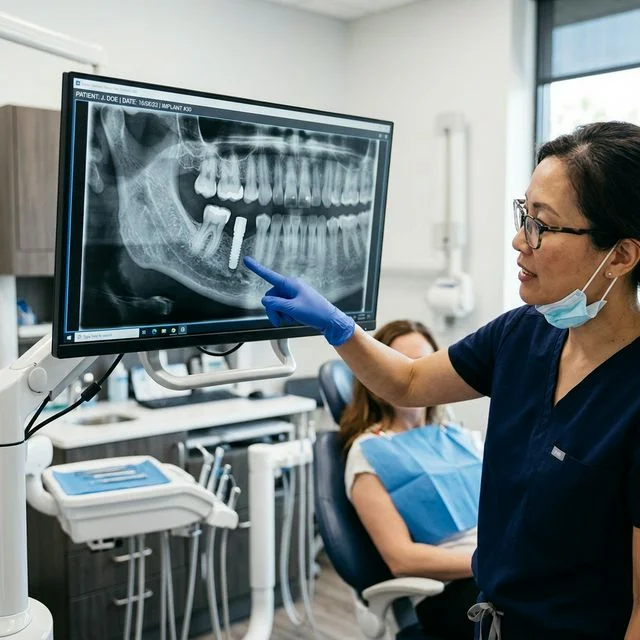
Single Tooth Implant: What's Included
A single tooth implant is a three-component system:
| Component | Material | Cost Range | Function |
|---|---|---|---|
| Implant post | Titanium or zirconia | $1,000–$1,500 | Screwed into jawbone; acts as artificial root |
| Abutment | Titanium or zirconia | $500–$800 | Connector between implant and crown |
| Crown | Porcelain, zirconia, or PFM | $1,000–$2,500 | Visible tooth; custom-matched to adjacent teeth |
Total cost: $3,000–$4,800 for a standard single tooth implant. Additional costs may include the consultation ($100–$250), CBCT scan ($250–$600), and bone grafting if needed ($300–$3,000).
Use our Cost Calculator to get a personalized estimate based on your city and insurance.
Cost Breakdown: Itemized Pricing
Here's what makes up the total cost of a single tooth implant, including all potential fees:
| Item | Cost Range | Always Required? |
|---|---|---|
| Initial consultation | $100–$250 | Yes |
| CBCT scan (3D X-ray) | $250–$600 | Yes |
| Tooth extraction (if needed) | $150–$350 | Sometimes |
| Bone graft (if needed) | $300–$3,000 | ~30% of cases |
| Implant post | $1,000–$1,500 | Yes |
| Abutment | $500–$800 | Yes |
| Crown | $1,000–$2,500 | Yes |
| Local anesthesia | Included | Yes |
| IV sedation (optional) | $300–$600 | No |
Realistic total: Budget $3,500–$5,500 for most single tooth implant cases when all fees are included.
Single Implant vs Dental Bridge: Complete Comparison
For a single missing tooth, the two main options are an implant and a traditional dental bridge. Here's an honest comparison:
| Factor | Single Implant | Dental Bridge (3-unit) |
|---|---|---|
| Cost | $3,000–$4,800 | $1,500–$5,000 |
| Lifespan | 25+ years (implant post) | 10–15 years |
| Affects adjacent teeth? | No — standalone | Yes — grinds down 2 healthy teeth |
| Bone preservation | Yes — prevents bone loss | No — bone continues to resorb |
| Flossing | Normal flossing | Requires floss threader |
| Treatment time | 4–6 months | 2–3 weeks |
| Success rate | 98% | 90–95% at 10 years |
| 20-year cost | $3,000–$5,000 (one-time) | $3,000–$10,000 (1–2 replacements) |
The verdict: A dental bridge is faster and sometimes cheaper upfront, but a single implant is the better long-term investment. The bridge requires sacrificing two healthy teeth and will likely need replacement at least once over 20 years.
Compare long-term costs: Implant vs Alternatives Calculator.
Single Implant vs Maryland Bridge vs Flipper Tooth
Beyond traditional bridges, two other temporary/conservative options exist:
| Option | Cost | Lifespan | Best For | Drawbacks |
|---|---|---|---|---|
| Single implant | $3,000–$4,800 | 25+ years | Permanent solution | Surgery, longer treatment time |
| Maryland bridge | $1,500–$2,500 | 5–8 years | Front teeth, minimal prep | Can debond; not for molars |
| Flipper tooth | $300–$500 | 1–2 years | Temporary while waiting for implant | Uncomfortable; can break easily |
| Dental bridge | $1,500–$5,000 | 10–15 years | Quick permanent solution | Grinds down adjacent teeth |
For more details: Dental Implant Alternatives.
Front Tooth vs Back Tooth: Different Considerations
Front Tooth Implants (Aesthetic Zone)
- Priority: Visual appearance — the implant must perfectly match adjacent teeth in color, shape, and gum line
- Crown material: All-ceramic (zirconia or lithium disilicate) preferred for natural translucency
- Additional cost: $500–$1,000 more for custom aesthetic crown and possible gum grafting
- Same-day option: Often recommended to maintain gum architecture
Back Tooth Implants (Functional Zone)
- Priority: Strength and chewing function — must withstand 200+ PSI of biting force
- Crown material: PFM (porcelain-fused-to-metal) or full zirconia for maximum durability
- Common issue: Less bone height due to maxillary sinuses (upper) — may require sinus lift
- Same-day option: Less common; delayed loading is often safer due to higher bite forces
The Timeline: Consultation to Final Crown
| Stage | When | What Happens |
|---|---|---|
| Consultation + planning | Day 1 | Exam, X-rays, CBCT scan, treatment plan |
| Tooth extraction (if needed) | Week 1–2 | Remove damaged tooth; may place bone graft |
| Implant placement | Week 2 or month 3–4 | 45–90 min surgery under local anesthesia |
| Healing cap/temporary | Same day | Healing abutment placed; temporary tooth if needed |
| Osseointegration | Months 2–5 | Bone fuses with implant (no visible change) |
| Impression + abutment | Month 4–6 | Final mold taken; custom abutment fabricated |
| Crown placement | Month 5–7 | Permanent crown cemented or screwed onto abutment |
Track each step: Recovery Timeline.
How to Choose the Right Implant Brand
For a single tooth implant, the brand affects cost, surface technology, and long-term performance. Our data on 40+ implant brands shows:
- Premium brands (Straumann, Nobel Biocare) — $3,500–$6,000 per implant. Best documented success rates (98%+). Recommended for front teeth and complex cases.
- Mid-range brands (Zimmer Biomet, BioHorizons) — $2,500–$4,500 per implant. Excellent track records with slightly lower cost.
- Budget brands (Osstem, Dentium) — $1,500–$3,000 per implant. FDA-cleared with 97%+ success rates. Best value for cost-conscious patients.
Compare brands side-by-side: Brand Comparator Tool.
Insurance Coverage for Single Tooth Implants
Insurance coverage for single tooth implants varies widely:
- Dental PPO plans: 3–5% cover implants; those that do typically pay 50% up to an annual maximum of $1,000–$2,500
- Dental HMO plans: Rarely cover implants
- Medical insurance: May cover the implant post (surgical component) if tooth loss resulted from an accident or medical condition — worth submitting a claim
- HSA/FSA: Dental implants are a qualified expense — save 22–35% through pre-tax contributions
Estimate your out-of-pocket cost: Insurance Savings Calculator.
No insurance? See our guide: Dental Implants Without Insurance.
Single Tooth Implant vs Dental Bridge: The Complete Comparison
If you are missing one tooth, your two primary options are a single implant or a traditional 3-unit dental bridge. This comparison covers every factor:
| Factor | Single Tooth Implant | 3-Unit Dental Bridge |
|---|---|---|
| 2026 Cost | $2,500–$6,000 | $1,500–$4,500 |
| Lifespan | 25+ years (implant), 15–20 years (crown) | 10–15 years, then replacement needed |
| 20-year total cost | $4,000–$8,000 (1 implant + 1–2 crown replacements) | $3,000–$9,000 (2 bridges needed over 20 years) |
| Bone preservation | Yes — implant stimulates jawbone like a natural tooth root | No — bone loss continues under the pontic (false tooth) |
| Adjacent teeth | Not affected — no grinding of healthy teeth | Requires grinding down 2 adjacent healthy teeth for crown supports |
| Treatment time | 3–6 months (including osseointegration) | 2–3 weeks (faster) |
| Surgery required? | Yes — minor oral surgery | No — non-surgical |
| Cleaning | Normal brushing and flossing like a natural tooth | Special floss threaders needed to clean under the pontic |
| Success rate | 95–98% (10-year) | 85–90% (10-year) |
| Insurance coverage | Partial (50% of major services, capped at $1,000–$2,500/year) | Better coverage (most plans cover bridges) |
Bottom line: A single implant is the better long-term investment for most patients. A bridge is appropriate if you cannot undergo surgery, need faster results, or the adjacent teeth already have large restorations (crowns).
Front Tooth Implant: Special Considerations
Replacing a front tooth (aesthetic zone) requires extra precision because it is the most visible area of your smile. Key considerations:
- Aesthetic demands: The gum line around a front tooth implant must be perfectly contoured to match the natural gum scallop. Even 1mm of gum recession will be visible and unattractive.
- Bone volume: The bone in the front of the mouth (anterior maxilla) is thinner than in the back. Bone grafting is more commonly needed for front tooth implants (~40% of anterior cases).
- Immediate provisional: Because of the visible location, a temporary crown is almost always placed at the time of surgery so you never have a visible gap. This adds $300–$500 to the total cost.
- Crown material: Full zirconia or layered zirconia crowns provide the best aesthetic match for front teeth. All-ceramic (no metal substructure) prevents dark shadows at the gum line.
- Surgeon choice: For front teeth, consider a periodontist or prosthodontist (specialist) rather than a general dentist for optimal soft tissue management and aesthetic outcomes.
Cost for front tooth implant: Typically 10–20% higher than a posterior implant due to material quality requirements and technique complexity. Expect $3,500–$7,000 including the temporary.
Single Tooth Implant Cost Breakdown (2026)
| Component | Cost Range | What Affects Price |
|---|---|---|
| Implant post | $1,000–$3,000 | Brand (Straumann vs Osstem), material (titanium vs zirconia) |
| Abutment | $300–$700 | Stock vs custom-milled; material |
| Crown | $800–$2,000 | Zirconia ($1,500+) vs porcelain-fused-to-metal ($800+) |
| CBCT scan | $150–$500 | Often included in consultation |
| Extraction (if needed) | $75–$650 | Simple vs surgical extraction |
| Bone graft (if needed) | $200–$3,000 | Minor socket graft vs major block graft |
| Surgical guide (optional) | $200–$500 | 3D-printed guided surgery template |
| Temporary crown (aesthetic zone) | $300–$500 | Needed for front teeth during healing |
Total: $2,500–$6,000+ depending on location, brand, and whether additional procedures are needed. For a detailed cost comparison across cities and financing options: Complete cost guide →
Healing Timeline: What to Expect Week by Week
| Phase | Timeline | What's Happening | Your Experience |
|---|---|---|---|
| Initial recovery | Days 1–3 | Blood clot formation, inflammatory response | Mild swelling, slight bleeding, managed with ice and pain medication |
| Soft tissue healing | Days 4–14 | Gum tissue heals around implant site | Swelling subsides, suture removal (if non-dissolvable), returning to normal |
| Early osseointegration | Weeks 3–8 | New bone cells migrate to implant surface | No symptoms; eat normally on opposite side |
| Bone maturation | Months 2–4 | Woven bone remodels into strong lamellar bone | Site feels completely normal; routine hygiene |
| Abutment + crown | Month 3–6 | Abutment attached, crown cemented | Final crown placed; full function restored |
Accelerated option: With advanced surface treatments (e.g., Straumann SLActive) and guided surgery, some patients qualify for crown placement in as few as 6–8 weeks. Ask your dentist if accelerated protocols are appropriate for your case.
Full procedure details: Step-by-step procedure guide →
When a Single Implant May Not Be the Best Option
While single implants are the gold standard, other solutions may be better in specific situations:
- Multiple adjacent missing teeth (2–4): An implant-supported bridge (2 implants supporting 3–4 crowns) is more cost-effective than individual implants for each tooth.
- All teeth missing: All-on-4 is far more economical and practical than placing 14 individual implants.
- Budget constraints: A Maryland bridge or removable partial denture can serve as a temporary solution while saving for an implant.
- Medical contraindications: Patients who cannot undergo surgery (uncontrolled diabetes, active cancer treatment, immunosuppression) should consider tooth-supported bridges.
- Adolescents: Dental implants should not be placed until jaw growth is complete (typically age 18+ for females, 21+ for males).
Not sure which option is right? See all replacement options compared →